
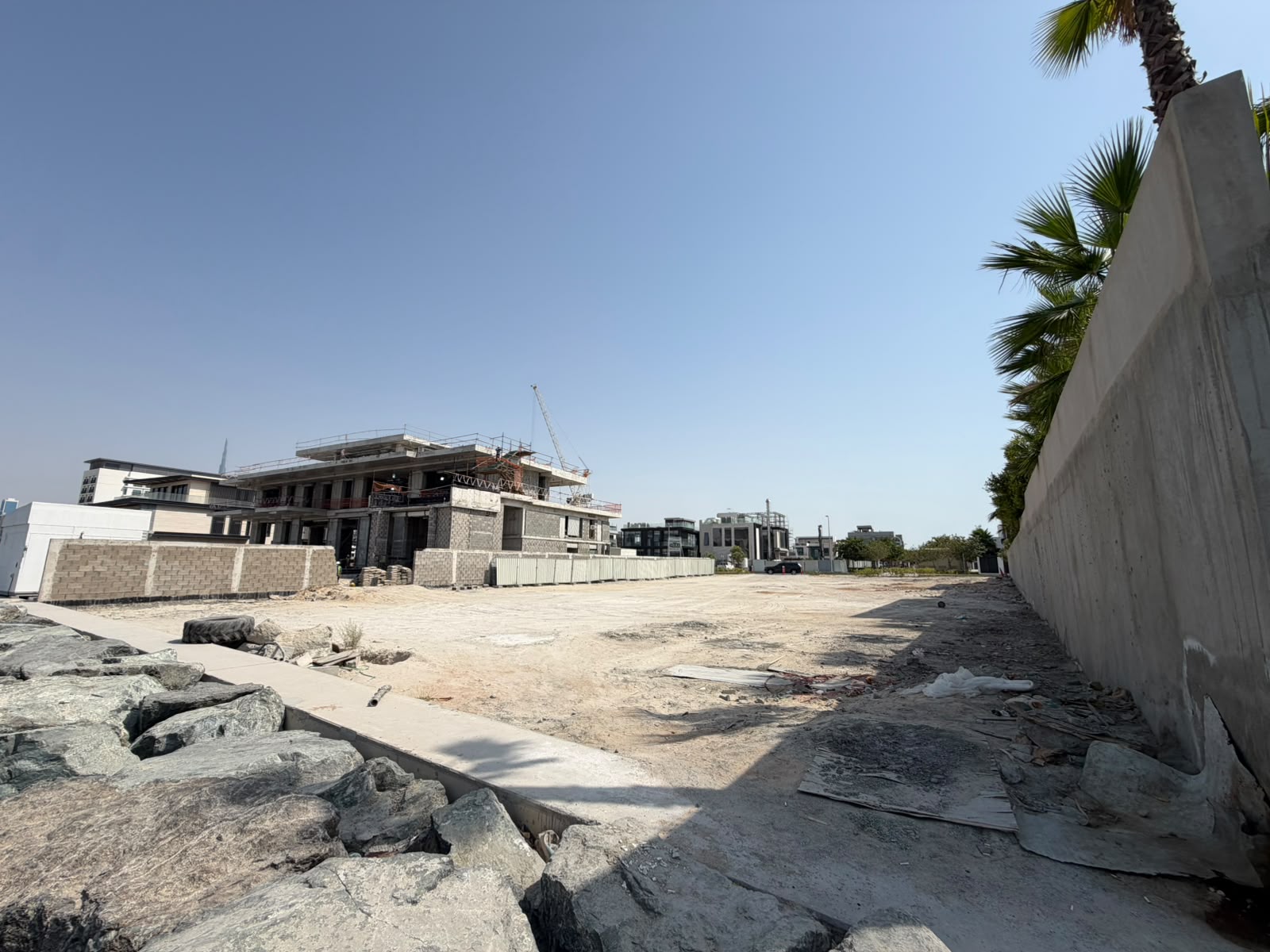
Buying Land in Dubai
Who Can Own a Plot, and What You Are Allowed to Build on It
Buying a plot is not buying a smaller version of a villa. A different law governs who may hold the title, a different document decides what you can build, and a permit clock starts running once you are ready to break ground. Here is how land ownership in Dubai actually works — and the checks that matter before you sign.
Who Is Actually Allowed to Own Land in Dubai
Most guides to Dubai property quietly skip the land question, because the answer is less generous than the headline about foreign ownership suggests. The governing instrument is Law No. (7) of 2006 Concerning Real Property Registration in the Emirate of Dubai, issued on 13 March 2006. Article 4 of that law restricts the right to own real property in the Emirate to UAE nationals, nationals of the Gulf Cooperation Council member states, companies wholly owned by them, and public joint stock companies.
That is the default position across Dubai. The exception, and it is a significant one, applies in areas approved by the Ruler. In those areas the same article permits non-UAE and non-GCC nationals to hold freehold ownership of real property without time restrictions, or usufruct or leasehold rights for a period not exceeding ninety-nine years. The areas themselves are set out in Regulation No. 3 of 2006 Determining Areas for Ownership by Non-Nationals of Real Property in the Emirate of Dubai, which the UAE Government portal identifies as the instrument designating Dubai’s freehold plots.
So the practical answer for a foreign buyer is: yes, you can own land in Dubai outright, but only inside the designated areas, and the designation attaches to the land rather than to you. This is the same architecture that governs apartments and villas, set out in our guide to freehold versus leasehold in Dubai. The difference with a plot is that there is no building to soften the consequences of getting the designation wrong.
Ownership also has to be registered to exist at all. Article 9 of Law No. 7 of 2006 provides that all transactions creating, transferring, amending or extinguishing real property rights must be recorded in the Property Register, and that such transactions will not be deemed valid unless recorded. A signed contract and a transferred payment do not, by themselves, give you a right in the land. The transaction becomes real when it is entered in the Dubai Land Department’s register and a title deed issues in your name — which is why plot purchases complete at a registration trustee office exactly as unit purchases do.
Land Ownership at a Glance
The legal position in one place
Freehold, Usufruct, Leasehold and Musataha
Land in Dubai is not a single product. Four distinct rights can attach to the same parcel, and they differ in what they let you do, how long they last, and who is allowed to hold them.
| Right | What It Gives You | Maximum Term | التوافر |
|---|---|---|---|
| ملكية حرة | Ownership of the land itself, together with anything built on it. The right that appears on a title deed in your own name. | No time restriction | Designated areas for non-GCC |
| Usufruct | The right to use and take the benefit of land you do not own, without altering its substance. Registered against the plot. | 99 years | Designated areas for non-GCC |
| Leasehold | A long lease of the land. Commercially similar to usufruct but structured as a landlord-and-tenant relationship. | 99 years | Designated areas for non-GCC |
| Musataha | The right to build on land belonging to someone else, and to own the building you put up for the term of the agreement. | 50 years | Common for commercial & institutional use |
Freehold, usufruct and the ninety-nine year leasehold limit are taken from Article 4 of Dubai Law No. (7) of 2006 Concerning Real Property Registration in the Emirate of Dubai, published on the Dubai Legislation portal and retrieved 1 September 2026. The fifty-year musataha maximum, and the right of either party to terminate on two years’ notice under Article 1356 of the UAE Civil Code, are taken from published legal commentary by Al Tamimi & Company. Law No. 7 of 2006 does not itself set a musataha term.
The Affection Plan Is More Important Than the Price
If a title deed answers the question who owns this plot, the affection plan answers the far more expensive question: what can be done with it. It is the official site plan issued for a plot by Dubai Municipality. DLA Piper’s Real World reference on Dubai planning and zoning describes it as a high-level general site plan carrying basic information including the plot number and the land use classification. Critically, it also specifies the height allowance, ، ال permitted usage, setback requirements and whether parking must be provided — and it identifies which government approvals will be required before development can proceed.
Read in that light, two plots of identical size and identical price in the same community can be worth very different amounts. One may be classified for a low-rise use with generous setbacks that consume much of the buildable area; the other may carry a height allowance supporting several additional floors. Nothing in the sale price tells you which is which. The affection plan does, and it costs a great deal less to obtain than the mistake costs to unwind.
The same reference notes that beyond Dubai Municipality itself, approvals from utilities, civil defence, environmental departments and other agencies listed on the affection plan must be secured. Where a plot sits inside a master-planned community, the master developer is frequently listed as an entity whose approval is required before the municipality submission is made — a second layer of design control on top of the municipal one, and usually the stricter of the two.
Six Checks Before You Commit to a Plot
Land transactions fail on questions that never arise when buying a finished unit. These are the six that matter most.
Published Fees on a Dubai Land Transfer
These are the fees the Dubai Land Department publishes. Everything else on a land deal — brokerage, conveyancing, developer NOC charges — is negotiated between the parties and has no official rate.
| Item | Published Amount | ملاحظات |
|---|---|---|
| رسوم انتقال DLD | 4% of sale value | Conventionally 2% seller and 2% buyer; in practice the buyer frequently bears the whole amount by agreement. |
| Registration trustee | AED 2,000 + VAT under AED 500,000 AED 4,000 + VAT at AED 500,000 and above | Paid at the trustee office where the transfer is completed. |
| Title deed issuance | ٢٥٠ درهم إماراتي | Flat fee across property types. |
| Knowledge fee | AED 10 | Standard administrative charge. |
| Innovation fee | AED 10 | Standard administrative charge. |
| Map / site plan fee | AED 225 unified Dubai Municipality map AED 250 villas and apartments AED 100 land outside Dubai Municipality | Which map applies depends on where the parcel sits. |
| Mortgage registration | 0.25% of mortgage value | Only where the purchase is financed. |
| Developer NOC | No published DLD rate | Set by the developer and varies by community. |
Fee lines reproduced from TruHauz’s own published Dubai Land Department fee breakdown. Fees are set by the DLD and can change — confirm the current schedule before you transact. We have deliberately not published a separate land registration administrative fee here, because we could not verify one against a primary DLD source.
Looking at a specific plot?
Send us the plot number and TruHauz will check the register position and read the affection plan before you commit.
What Happens After You Own the Land
Ownership is the beginning of the project, not the end of the transaction. Three things govern what follows.
The Planning Regime
Development work in Dubai operates under a permit system established by Dubai Law No. 16 of 2023 on Urban Planning in the Emirate of Dubai, which took effect on 5 October 2023. Dubai Municipality is the authority primarily responsible for urban planning regulation, permit review and issuance, compliance monitoring and enforcement.
The Permit Clock
A building permit remains valid for six months. If construction has not commenced within that window, the permit must be extended or applied for again. That makes contractor procurement a scheduling question rather than an administrative one — the permit should be timed to the start on site.
Municipality and Master Developer
In a master-planned community you pass through two design approvals, not one. The master developer’s consent is generally required before the municipality submission, and its design code is often the tighter constraint of the two.
الأسئلة المتداولة
The questions buyers ask most often about buying land in Dubai.
Check the Plot Before You Buy It
TruHauz reviews the register position, the ownership route and the affection plan on every land transaction we advise on — so you know what you can build before you own it. Tell us which plot you are looking at.


انضم إلى المناقشة