District Cooling Charges in Dubai: What a Provider Can Legally Bill

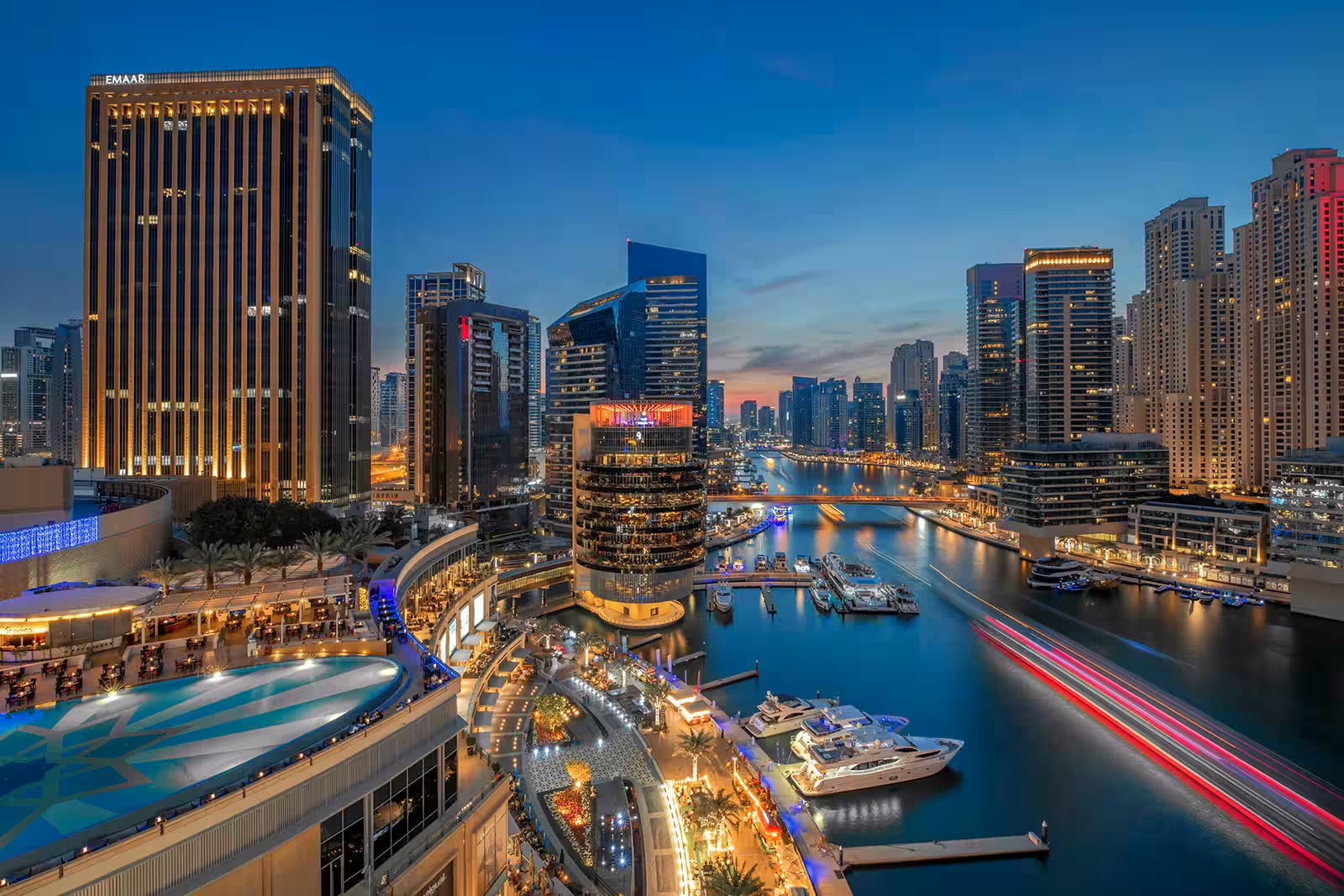
Дубай Марина ночью
Ownership Costs · Utilities · Updated August 2026

District Cooling Charges in Dubai
Every Charge a Provider Can Legally Bill, and the Caps That Limit Them

Cooling is usually the largest running cost of occupying a Dubai apartment, and the bill that generates the most disputes. It is also one of the most tightly regulated. Dubai’s Regulatory and Supervisory Bureau publishes a closed list of the charges a district cooling provider is allowed to apply — and caps on several of them. Here is that list, what each charge means, and what your provider cannot bill you for.

🏛️ RSB Regulated
📋 RD10 v1.4 · Feb 2026
🚫 No Other Charges Permitted
AED 0.643Consumption Tariff Cap Per RTh
AED 30Billing Services Fee Cap Per Month
8 MonthsMaximum Deposit Of Capacity Charges
16Charges On The Permitted List
The Basics

How District Cooling Billing Actually Works

District cooling is a central plant that chills water and pipes it to a whole development, instead of every apartment running its own condenser. Most large Dubai towers and master communities are built this way. The consequence for residents is that cooling does not arrive on the DEWA bill — it arrives as a separate invoice from a cooling provider, calculated on a logic that catches a lot of people out.

That logic has two halves. The capacity charge pays for cooling capacity being held available for your unit. The consumption charge pays for the cooling energy you actually draw. In the regulator’s language, the Capacity Tariff is the unit charge normally quoted in dirhams per year for each refrigeration-ton of cooling capacity made available to the customer, and the Capacity Charge is that tariff multiplied by your Contracted Capacity, normally applied monthly. The Consumption Tariff is the unit charge in dirhams for each refrigeration-ton-hour consumed, and the Consumption Charge is that tariff multiplied by your metered consumption.

This is the single most important thing to understand before you buy or rent in a district-cooled building: the bill does not go to zero when the unit is empty. The capacity element is charged on availability, not on usage. An owner holding a vacant apartment, or an investor between tenancies, still carries the capacity charge. It is a genuine cost of ownership and it belongs in a yield calculation next to the service charge, not as an afterthought.

What makes Dubai unusual is how closed the list of permitted charges is. District cooling is regulated by the Regulatory and Supervisory Bureau for the Electricity and Water Sector — the RSB — under Executive Council Resolution No. 6 of 2021, which regulates the provision of district cooling services in the Emirate of Dubai. The RSB publishes a regulatory document, RD10, setting out the approval of district cooling tariffs, charges and fees. RD10 does not merely describe the charges; it states that only the tariffs, charges and fees expressly identified and authorised in it may be applied, and that no other charges may be levied by Permit Holders.

Перспектива TruHauz: Treat cooling as a due-diligence item with the same weight as the service charge. Two towers quoting a similar rate per square foot can have very different true running costs depending on whether cooling is bundled into the service charge or billed separately on top — a point we make in our Dubai service charges guide. The body that signs off the building’s budget is covered in our owners’ association and Mollak guide, and who pays what between landlord and tenant should be written into the lease itself — see our Dubai tenancy contract guide.

District Cooling at a Glance

The regulated essentials in one place

РегуляторRSB Dubai
Legal basisExec. Council Res. 6 of 2021
Tariff documentRD10, version 1.4
Caps approved byDSCE
Charges permittedListed ones only
Consumption tariff capAED 0.643 / RTh
Fuel surcharge capAED 0.075 / RTh
Billing services fee capAED 30 / month
Activation fee capAED 200 (units)
Deposit cap8 months capacity
Low delta-T on unit billsNot permitted
The Permitted List

Every Charge a Dubai Cooling Provider May Apply

RD10 sets out a closed list. If a line on your invoice is not one of these, it is not an approved district cooling charge. Where a cap is shown as “per Schedule 3”, the figure is assessed and approved for each cooling system individually rather than published as one national number.

Charge Unit Cap What It Is
Capacity TariffAED / TR / yearPer Schedule 3The annual charge for each refrigeration-ton of capacity made available to you. RD10 states that tariff arrangements including indexation or escalation of capacity charges will not be approved.
Consumption TariffAED / RTh0.643Where there is an associated Capacity Tariff. The cap is inclusive of the fuel surcharge.
Composite TariffAED / RThPer Schedule 3Used where there is no associated Capacity Tariff. May incorporate a true-up rate or minimum demand assumption to account for deviations from an agreed consumption baseline.
Consumption Tariff — single building systemsAED / RTh0.80For a system serving only one building. No capacity charges may be charged to units on these systems, and the levy requires a binding contractual arrangement specifying standalone cooling charges.
Fuel SurchargeAED / RTh0.075Reconsidered by the DSCE when DEWA’s fuel surcharge changes or industry efficiency improves.
Connection ChargeAED / TRPer Schedule 3A one-time charge on first connection to the district cooling system.
Inefficient Building Penalty (low delta-T)АЕДPer Schedule 3Levied on a building, subject to the RSB assessment protocol and the cooling services agreement. May never appear on a unit bill.
Billing Services FeeAED / month30The total of all fixed monthly charges for providing billing services.
Activation FeeАЕД200Units only. Applied once, when a new customer first receives billing services at that unit.
Meter Verification FeeАЕДPer Schedule 3Charged for verifying the accuracy of a cooling meter.
Re-connection FeeАЕД500 (units)Capped at AED 500 for units; per Schedule 3 for buildings. This is the figure RD10 version 1.4 was issued to adjust.
Late Payment FeeАЕД100 (units)Applied per billing cycle. Accumulated late payment fees may never exceed 100% of the aggregate outstanding charges.
Default Payment FeeАЕДPer Schedule 3May not be higher than fees already approved for that provider.
DepositMonths of capacity charges8 monthsAdjustment of an existing unit deposit is only allowed on a change or renewal of ownership or of the rental agreement.
Excess Demand Fee% of Capacity Tariff120%Buildings only. Applied when average demand exceeds contracted capacity during a four-hour period.
Meter Tampering Penalty%10% + repairMust be based on the actual cost of repair or replacement plus 10%.

Source: Regulatory and Supervisory Bureau for the Electricity and Water Sector (RSB Dubai), RD10 — Regulation on the Approval of District Cooling Tariffs, Charges and Fees, version 1.4, published 6 February 2026, issued pursuant to Executive Council Resolution No. (6) of 2021. TR = refrigeration-ton; RTh = refrigeration-ton-hour. Retrieved from rsbdubai.gov.ae.

Должная осмотрительность

Six Checks Before You Sign in a District-Cooled Building

Each of these takes minutes and can change what a property actually costs you to hold or occupy.

Find the Contracted Capacity
Check 01 · The Big One
TR refrigeration-tons allocated
Почему это важноSets the fixed charge
Ask forThe allocation in writing
Red flagNobody can tell you
ProhibitedDiscriminatory allocation
Bundled or Billed Separately
Check 02 · Structure
Either and it changes everything
Option AInside service charge
Option BSeparate provider bill
СпроситьExplicitly, in writing
AffectsTrue cost comparison
Check the Deposit Demanded
Check 03 · Cash Up Front
8 Months of capacity charges, maximum
Cap8 months equivalent
Revisited onOwnership change
Or onTenancy renewal
Separate fromConnection charge
Scan for Unlisted Charges
Check 04 · The Invoice
Closed list of permitted charges
RuleNo other charges
Compare againstThe RD10 list
Also requiredClear disclosure
If unlistedChallenge it
Reject Low Delta-T on a Unit Bill
Check 05 · Never Permitted
Never on an individual unit invoice
RD10 saysNot under any circumstances
Applies toBuildings only
ТребуетRSB protocol compliance
If billedDispute it
Model the Vacant Period
Check 06 · Investors
Not Zero what an empty unit still costs
Capacity chargeContinues
Consumption chargeFalls away
Add toVoid-period budget
AlongsideService charge

Not sure what cooling costs in the building you are considering?

Tell us the tower or community and TruHauz will establish how cooling is supplied and billed before you commit.

Ask TruHauz →
The Protections

Three Rules in RD10 Worth Knowing By Heart

Most cooling disputes are not really about the tariff. They are about a charge that should not be there, an allocation nobody can justify, or a fee that has quietly compounded.

Closed

The list is exhaustive

RD10 states that only the tariffs, charges and fees expressly identified and authorised in it may be applied, and that no other charges may be levied by permit holders. It also requires every approved charge to be clearly disclosed to the customer, and any later adjustment approved by the DSCE to be notified in a timely and transparent manner.

Fair

Capacity must be allocated properly

Where a provider passes capacity and consumption charges through to units, it may only apply charges it has been authorised to apply at that building. It is prohibited from assigning contracted capacity to units based on installed equipment capacity rather than appropriate allocation, and from allocating capacity among units in a discriminatory or inconsistent manner.

100%

Late fees cannot run away

Late payment fees are applied per billing cycle, and RD10 states that the total accumulated late payment fees at any time shall not exceed one hundred per cent of the aggregate outstanding charges. For units the late payment fee is capped at AED 100 and the re-connection fee at AED 500.

Итог: your cooling tariff itself is set building by building. Capacity tariffs and connection charges are assessed and approved for each district cooling system individually and recorded in Schedule 3 of that provider’s permit, so there is no single published figure that applies across Dubai — which is precisely why you have to ask for the numbers that apply to your building rather than assume a market rate. What is published are the caps, the closed list of permitted charges, and the conduct rules above. Tariffs are not static either: the DSCE resets consumption tariffs and the fuel surcharge when DEWA’s electricity and water tariffs change, will consider a reset when Dubai Municipality tariffs change, and may adjust tariffs at any time in light of industry water sourcing, efficiency improvements and operating costs. If you believe you have been billed something outside the permitted list, RD10 is explicit that implementing unapproved tariffs, charges or fees constitutes a violation of the Resolution and the permit conditions, and is subject to regulatory enforcement.
Часто задаваемые вопросы

Часто задаваемые вопросы

The questions owners and tenants ask most often about district cooling charges in Dubai.

What charges can a district cooling provider legally bill in Dubai?+
Only the charges expressly listed and authorised in RSB Regulatory Document RD10 may be applied. RD10 states that no other charges may be levied by Permit Holders. The permitted list covers the Capacity Tariff, the Consumption Tariff, a Composite Tariff where there is no associated Capacity Tariff, a separate Consumption Tariff for Single Building District Cooling Systems, the Fuel Surcharge, the Connection Charge, the Inefficient Building Penalty, the Billing Services Fee, the Activation Fee, the Meter Verification Fee, the Re-connection Fee, the Late Payment Fee, the Default Payment Fee, the Deposit, the Excess Demand Fee and the Meter Tampering Penalty. Anything billed to you outside that list is not an approved charge, and RD10 also requires every approved tariff, charge and fee to be clearly disclosed to the customer.
What is the difference between the capacity charge and the consumption charge?+
The capacity charge pays for cooling capacity being made available to you, and the consumption charge pays for the cooling energy you actually use. RD10 defines the Capacity Tariff as the unit charge normally quoted in dirhams per year for each refrigeration-ton of cooling capacity made available to the customer, and the Capacity Charge as the Capacity Tariff multiplied by your Contracted Capacity, normally applied monthly. The Consumption Tariff is the unit charge in dirhams for each refrigeration-ton-hour of cooling energy consumed, and the Consumption Charge is that tariff multiplied by metered consumption, normally calculated monthly. This is why a district cooling bill does not fall to zero when a unit sits empty: the capacity element is charged on availability, not on usage.
Is there a cap on district cooling tariffs in Dubai?+
Yes. RD10 sets caps approved by the Dubai Supreme Council of Energy. The Consumption Tariff, where there is an associated Capacity Tariff, is capped at AED 0.643 per refrigeration-ton-hour inclusive of the Fuel Surcharge, and the Fuel Surcharge itself is capped at AED 0.075 per refrigeration-ton-hour. The Consumption Tariff for Single Building District Cooling Systems is capped at AED 0.80 per refrigeration-ton-hour. The Billing Services Fee is capped at AED 30 per month and the Activation Fee at AED 200 for units. Capacity Tariffs and Connection Charges are not set at a single published number; they are assessed and approved for each district cooling system individually and recorded in Schedule 3 of that provider’s permit.
Can my district cooling provider charge me a low delta-T or inefficient building penalty?+
Not on a unit bill. RD10 states that Inefficient Building Penalties may not be applied in the bills charged to Units under any circumstances. The penalty exists in the regulation, but it is levied on a building where the building fails to meet the performance specified in the Cooling Services Agreement, and its use is subject to compliance with the RSB assessment protocol published on the RSB website and must be included in the Cooling Services Agreement. If a low delta-T or inefficiency charge appears as a line on an individual apartment bill, that is a charge worth challenging with the provider and, if unresolved, raising with the RSB.
How much deposit can a district cooling provider ask for?+
RD10 caps the Deposit at the equivalent of eight months of Capacity Charges, and it must not exceed that unless otherwise approved. The regulation also limits when an existing deposit can be revisited: adjustment of current deposits for units is only allowed on a change or renewal of ownership or of the rental agreement. That matters at handover and at every lease renewal, because it is the point at which a deposit can legitimately be recalculated. The deposit is separate from the one-time Connection Charge and from the Activation Fee, which RD10 caps at AED 200 for units and allows only once, at the time a new customer first receives billing services at that unit.
Who regulates district cooling in Dubai and where do I complain?+
District cooling in Dubai is regulated by the Regulatory and Supervisory Bureau for the Electricity and Water Sector, known as the RSB, under Executive Council Resolution No. 6 of 2021 regulating the provision of district cooling services in the Emirate of Dubai. Tariffs and caps are approved by the Dubai Supreme Council of Energy on the RSB’s recommendation. RD10 states that failure by a Permit Holder to apply tariffs, charges and fees in accordance with the regulation, or to implement unapproved tariffs, charges or fees, constitutes a violation of the Resolution and of the Permit Conditions and is subject to regulatory enforcement. Any entity that applies, levies or collects district cooling charges without a valid RSB permit is also subject to enforcement action. Raise a billing dispute with your provider first, then with the RSB.
Related reading: Cooling is one half of the true running cost of a Dubai apartment — the other is the annual service charge and what it does to net yield. The entity that approves the building’s budget and appoints its manager is explained in our owners’ association and Mollak guide. If you are letting the unit, the tenancy must be registered — see Ejari registration — and how much the rent can legally rise is set by the RERA rental index. Cooling arrangements differ sharply between high-amenity towers in Дубай Марина and villa stock in Дубай Хиллс Эстейт, which is worth weighing against the yields in our Dubai property price breakdown.

Отказ от ответственности: This guide summarises publicly published regulatory material for general information and is not legal advice. Tariffs, charges and caps are amended from time to time by the Dubai Supreme Council of Energy and the RSB, and the tariffs that apply to any specific building are those recorded in the relevant provider’s permit. Always verify the current position with the RSB and with your cooling provider, and take professional advice on a specific dispute.

Поговорить с TruHauz

Know the Real Running Cost Before You Buy

TruHauz establishes how a building is cooled, how it is billed and what it costs during a void — so the yield you are quoted is the yield you actually get. Tell us what you are looking at.

📞Телефон / WhatsApp+971 52 971 5488
📧Электронная почтаinfo@truhauz.com
🏢Лицензия RERA60838 — Dubai, UAE

Присоединяйтесь к обсуждению