
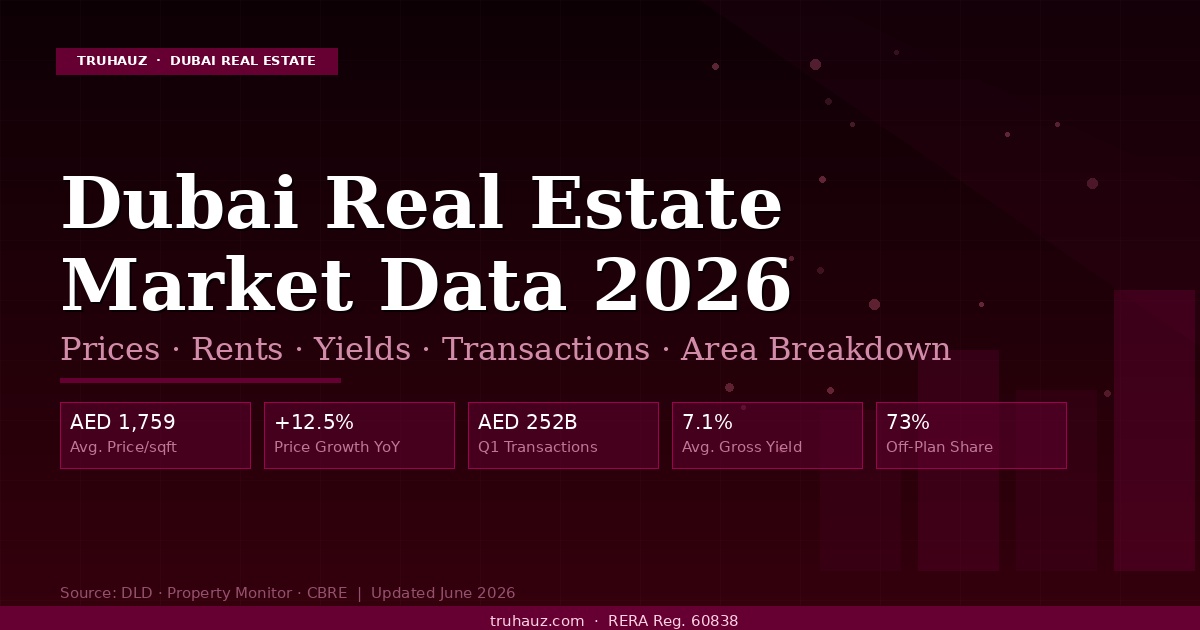
Dubai Real Estate Market Report: Q3 2026
Slower Volumes, Softer Prices, Busier Secondary Market
The third-quarter numbers are in, and they do not say what either the bulls or the bears want them to. Transaction volumes eased. The average price per square foot posted its first annual decline since February 2021. The secondary market grew more than 20 per cent on the quarter while off-plan stayed the largest segment. And the published totals disagree with each other by billions, for reasons worth understanding. Every figure below is attributed to the report it came from, with its date.
What Actually Happened in Q3 2026
A market cooling in volume while prices hold broadly steady on a like-for-like basis. Those are two different stories, and most coverage runs them together.
Savills published its Dubai Residential Market Report for Q3 2026 on 12 October 2026. It recorded approximately 34,500 residential transactions worth AED 70.8 billion, a fall of 4 per cent quarter on quarter. Alongside the slowdown in sales, it reported that rental activity rebounded by 16 per cent quarter on quarter and that ready-property transactions strengthened.
On pricing, Savills drew a careful distinction that is worth repeating in full, because it is the single most useful sentence written about the Dubai market this quarter: headline apartment and villa prices softened, while like-for-like pricing remained relatively stable, indicating limited repricing across comparable properties. In plain terms, the average came down partly because the mix of what sold changed, not because every owner took a markdown. The prime residential segment, Savills noted, continued to show resilience despite lower transaction volumes.
Springfield Properties, in a Q3 2026 review issued as a press release through Zawya, measured the quarter on a wider basis. Including commercial deals, it put total Dubai real estate activity at AED 90.62 billion across 36,738 transactions. Its residential figure was AED 72.58 billion across 33,949 transactions. The two houses therefore disagree on the residential count by roughly 550 deals and on residential value by about AED 1.8 billion — a point we return to below, because understanding the gap is more useful than picking a winner.
The First Annual Price Decline Since February 2021
The headline that defined the second half of 2026 — and what it does and does not mean.
Average price per sq ft
Dubai residential, August 2026, per Cavendish Maxwell figures published 7 September 2026.
Year on year
Against August 2025 — described as the first annual decline since February 2021.
Over three months
The three-month movement to August 2026 on the same measure.
August sales value
Residential sales recorded in the month of August 2026.
Homes sold in August
Around 14% fewer than July, attributed partly to the summer slowdown.
Year to date value
Nearly AED 270bn over the first eight months, down 24% on the same period of 2025.
Ronan Arthur, Director and Head of Residential Valuation at Cavendish Maxwell, said prices are softening and the market is entering a more mature cycle. He added that the fundamentals driving Dubai real estate demand in the emirate remain intact, citing fewer launches, regional uncertainty and a broader normalisation in buyer activity as the influences shaping the near term.
Hold that against the Savills observation about like-for-like pricing and a coherent picture appears. A 1.7 per cent annual move is not a crash; it is the sound of a market that ran hard for four and a half years finding a level. The risk for an individual buyer or seller is not the emirate-wide average at all — it is whether their specific building, in their specific sub-market, is tracking that average or diverging from it. Our guide to property valuation in Dubai covers how to establish that, and our Dubai property price breakdown tracks the longer series.
Off-Plan Still Biggest, Secondary Growing Fastest
The most important structural shift of the quarter, and the one most likely to persist.
| Segment | Q3 2026 value | المعاملات | Quarter-on-quarter | Source |
|---|---|---|---|---|
| Residential — off-plan | AED 41.58B | 23,457 | Largest residential segment | Springfield Properties |
| Residential — secondary | AED 30.83B | 10,442 | Value +24.22%, volumes +22.52% | Springfield Properties |
| Residential — all (Springfield) | AED 72.58B | 33,949 | — | Springfield Properties |
| Residential — all (Savills) | AED 70.8B | ~34,500 | Transactions −4% | Savills, 12 Oct 2026 |
| Commercial — all | AED 18.04B | 2,789 | Volumes broadly in line with Q2 | Springfield Properties |
| Commercial — land | AED 6.91B | — | 38.30% of commercial value | Springfield Properties |
| Commercial — offices | AED 4.35B | 1,123 | Up from 1,005 deals in Q2 | Springfield Properties |
| Commercial — whole buildings | AED 3.64B | 87 | 20.18% of value, from 13.40% in Q2 | Springfield Properties |
| All sectors combined | AED 90.62B | 36,738 | — | Springfield Properties |
Off-plan remains the largest residential segment in Dubai by a wide margin, and Cavendish Maxwell put it at around 75 per cent of August 2026 sales. But the growth in the quarter came from the other side of the market. A secondary segment rising more than 24 per cent in value and more than 22 per cent in volume, inside a residential market that fell 4 per cent overall, is a meaningful rotation rather than noise. Savills recorded the same direction independently, noting that ready-property transactions strengthened.
There is a plausible reading. With a very large completion pipeline ahead and launch activity slowing, buyers who want certainty on delivery are increasingly willing to pay for a finished home instead of a payment plan. If you are weighing the two, our comparison of off-plan versus ready property in Dubai sets out the trade-offs, and handover delays in Dubai covers what recourse exists when a completion date slips.
On the commercial side, the concentration is striking: land, offices and whole buildings together accounted for 82.60 per cent of commercial value in the quarter. Office deals rose to 1,123 from 1,005 in Q2, and whole-building transactions jumped to 20.18 per cent of commercial value from 13.40 per cent. For buyers looking at that market, see our guides to buying office space in Dubai و commercial property in Dubai.
Where the Transactions Happened
The busiest districts in Q3 2026 were the ones supplying new stock under AED 3 million. That is the whole story of the quarter in one sentence.
The airport district took first place by a wide margin. See our Dubai South villas and apartments guide for what is selling and at what price.
One of the few established mid-market districts still growing its transaction count. Our JVC property guide covers prices and yields.
The surprise of the quarter: a port-and-free-zone district with no beach or skyline, third in the emirate on volume. See our Jebel Ali property guide.
Named among the most active locations in the Springfield review, but without figures, so we have not estimated any. See our Dubai Marina area page.
The price-band data explains the ranking. Springfield recorded 84.28 per cent of residential transactions below AED 3 million in Q3 2026, up from 82.45 per cent in the second quarter, with 44.04 per cent between AED 1 million and AED 3 million and 40.24 per cent below AED 1 million. Four in every ten Dubai homes that changed hands in the quarter cost less than a million dirhams. The districts at the top of the activity table are simply the ones that can still supply that product.
Average prices by property type in the same review were AED 2,216 per square foot for villas, AED 1,794 for apartments and AED 1,341 for townhouses. Note that the townhouse average sits well below the apartment average — a reminder that per-square-foot comparisons across different product types tell you about unit size and location as much as about value.
Why the Headline Numbers Disagree
Three legitimate reasons, one arithmetic wrinkle, and why you should always cite a source and a date.
Readers comparing Q3 2026 coverage will find residential totals ranging from roughly 33,900 to around 34,500 transactions and values from AED 70.8 billion to AED 72.58 billion, with all-sector totals above AED 90 billion. The differences are not errors so much as different questions being answered.
Scope. The largest single gap — AED 70.8 billion against AED 90.62 billion — is simply residential-only against residential plus commercial. Springfield put commercial at AED 18.04 billion across 2,789 transactions, which accounts for most of it.
Definitions. Providers differ on whether to include plot sales, bulk transfers, gifted properties and particular classes of off-plan registration. None of those choices is wrong; they are simply not the same choice.
Timing. Dubai Land Department records are revised as late registrations are filed. A report compiled on 12 October and one compiled a fortnight later are drawing from different versions of the same underlying data.
And the arithmetic. Worth noting plainly: in the Springfield figures, off-plan value of AED 41.58 billion plus secondary value of AED 30.83 billion sums to AED 72.41 billion against a stated residential total of AED 72.58 billion, and the corresponding transaction counts of 23,457 and 10,442 sum to 33,899 against a stated 33,949. Minor discrepancies of this kind are common in quarterly press releases and do not undermine the broader picture, but they are a good argument for treating any single headline figure as one provider’s estimate on one date rather than the market’s official result.
The Number That Matters Most for 2027
Savills reported that more than 525,000 residential units are scheduled for delivery between 2027 and 2030. That is the figure to keep in view through every quarter from here, because a completion pipeline on that scale is the main thing capable of moving Dubai pricing in a sustained way.
Savills also offered the counterweight in the same report: lower launch activity and delayed project completions are expected to moderate near-term supply pressure. Scheduled is not delivered. Dubai’s handover schedules have historically slipped, and a pipeline that arrives over six years behaves very differently from the same pipeline arriving over three. Our analysis of the Dubai handover wave covers how completion timing has actually behaved.
For buyers, the practical implications are undramatic but real. Ready stock should carry more negotiating room than it did at the top of the cycle, which is part of what the secondary market’s 24 per cent quarterly value growth is telling us. Off-plan purchases deserve more scrutiny of the developer’s delivery record and the handover quarter than of the payment plan headline — see our guides to Dubai developers and their track records و buying on instalments. And anyone funding with debt should factor the rate environment in, which we cover in UAE interest rates and Dubai mortgages.
If you are weighing whether this is a moment to buy at all, our standing assessment is in is it a good time to buy property in Dubai, and the previous instalment of this series is the September 2026 market report.
What We Left Out, and Why
Several figures circulating in Q3 coverage are not in this report. Here is the list and the reason.
We omitted the following because we could not retrieve and verify them from the originating report in the course of writing: a year-on-year change in Q3 2026 residential transaction volumes, which is widely quoted but which we could not confirm against the Savills report page itself; the count of residential transactions above AED 10 million in Q3 2026 and the comparable Q2 figure; a September 2026 price-per-square-foot reading, which was not published in the sources we retrieved; apartment-versus-villa price percentage movements for the quarter; prime-segment transaction counts and values, which Savills described qualitatively without figures; and any rental yield, average rent or service charge figure for the quarter.
What is here instead, with sources: the Savills Dubai Residential Market Report Q3 2026, published 12 October 2026, for residential transaction counts and value, the quarter-on-quarter change, the rental rebound, the like-for-like pricing observation and the 2027–2030 delivery pipeline; the Springfield Properties Q3 2026 review, issued as a press release through Zawya, for segment, price-band, location, property-type and commercial breakdowns; and Cavendish Maxwell figures published on 7 September 2026 for the August price per square foot, its annual and three-month movements, August sales value and volume, the off-plan share of August sales, the year-to-date value and the quoted comments from Ronan Arthur.
This report is general information about a property market. It is not investment, tax or legal advice, and it is not a valuation of any specific property. Quarterly market data describes what has already happened; it does not forecast what any individual asset will do next. For a current valuation on a specific unit, see property valuation in Dubai, or ask us and we will pull the comparables.
الأسئلة المتداولة
What readers ask most often about the Dubai property market in the third quarter of 2026.
Turn Q3 Data Into a Decision on One Property
Quarterly averages do not value a specific unit. TruHauz pulls the comparables for the building you are actually looking at, checks the developer and the handover position, and tells you where the asking price sits.

انضم إلى المناقشة