
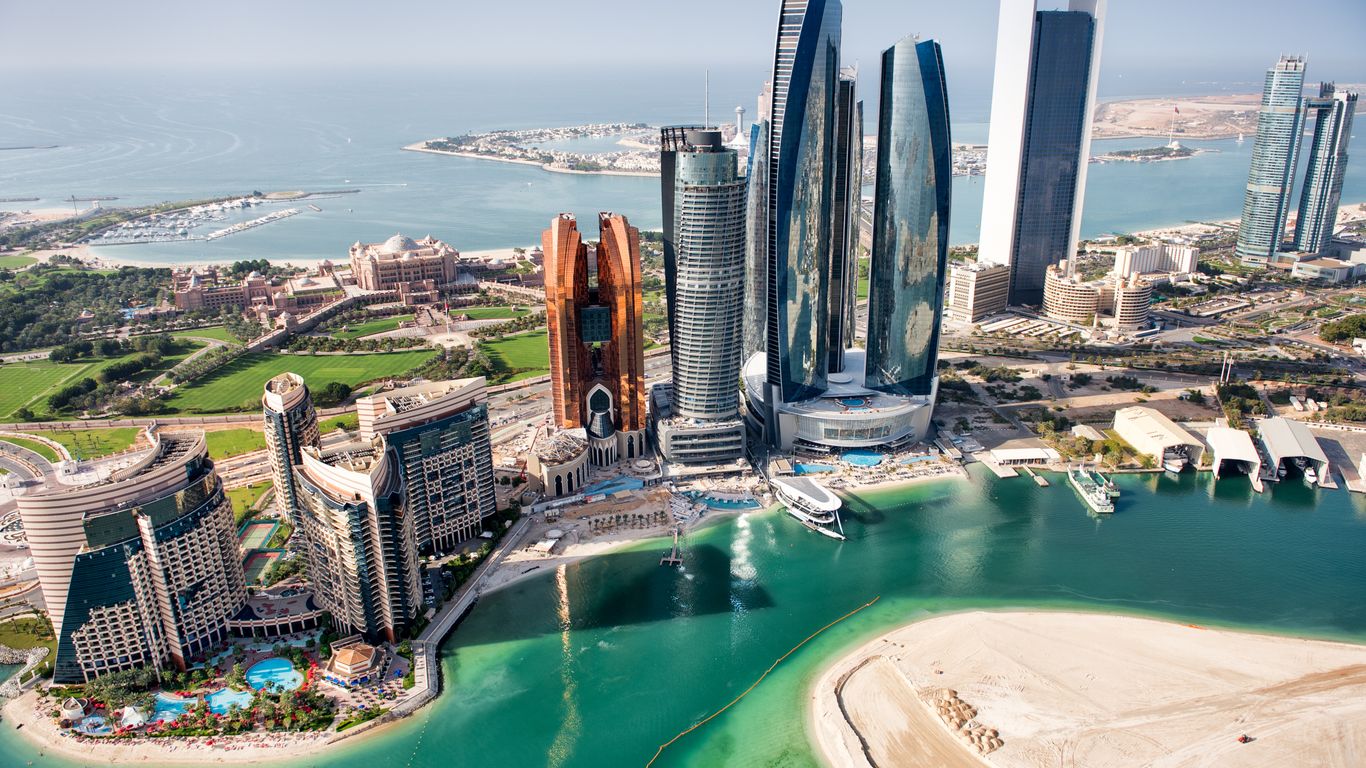
Dubai vs Abu Dhabi
Where Should You Actually Invest?
Two emirates, two very different propositions. Abu Dhabi is posting the stronger price growth. Dubai has roughly five times the transaction depth. This is a like-for-like comparison built only on figures published in the first half of 2026, with the source named against every number — including the places where the answer is Abu Dhabi.
Two Markets Moving in Opposite Directions
Most comparisons of these two emirates are written by someone who sells in one of them, and it shows. The genuine answer in 2026 is that Dubai and Abu Dhabi are not competing for the same investor at all — and for the first time in years, the momentum is not in Dubai’s favour.
Abu Dhabi is in an appreciation cycle. Dubai is in a consolidation. ValuStrat’s Price Index for Abu Dhabi freehold residential property reached 151.1 points in Q2 2026, up 2.1 per cent on the quarter and 17.8 per cent year on year, with apartments outperforming villas. Dubai’s residential index went the other way, easing to 220 points in June 2026 and leaving cumulative values about 10 per cent below their late-February level, with annual growth broadly flat at 0.1 per cent.
That does not make Abu Dhabi the better buy. It makes it the better recent performer, which is not the same thing, and the two indices are built on different baskets and different base periods — compare the directions, never the point values.
Below, each factor is taken in turn — ownership law, entry price, yield, fees, visa, liquidity and tenant demand — with the source and publication date attached. Where a figure could not be verified, it is left out and flagged rather than estimated.
Dubai vs Abu Dhabi — At a Glance
First half 2026, sourced figures
Like-for-Like: Same Source, Same Period, Same Metric
The only fair way to compare prices across two emirates is to use one research house applying one methodology to both. These are Bayut’s H1 2026 asking-price and projected-ROI benchmarks for each market, band by band.
| بخش | Dubai Benchmark | Dubai Price & Best ROI in Band | Abu Dhabi Benchmark | Abu Dhabi Price & ROI |
|---|---|---|---|---|
| آپارتمانهای مقرونبهصرفه | دبی سیليکان اویسیس | AED 1,086 psf · band best 9.06% (Discovery Gardens) | Al Reef | AED 1,065 psf · 8.92% |
| Mid-tier apartments | دایرهٔ روستای جمیرا | AED 1,470 psf · band best 7.69% (Al Furjan) | جزیره آل ریم | AED 1,690 psf · 6.34% |
| Luxury apartments | مارینا دبی | AED 2,111 psf · band best 6.41% (Sobha Hartland) | جزیره یاس | AED 2,393 psf · 5.94% |
| Ultra-luxury apartments | پالم جمیرا | AED 3,529 psf · band best 6.48% (Al Barari) | جزیره سعدیات | AED 3,893 psf · 3.51% |
| Affordable villas | داماک هیلز ۲ | AED 1,072 psf · 5.97% | الظفرة | AED 768 psf · 5.29% |
| Mid-tier villas | الفرجان | AED 1,677 psf · band best 6.09% (DAMAC Lagoons) | Al Raha Gardens | AED 984 psf · 5.91% |
| ویلاهای لوکس | املاک تپههای دبی | AED 2,870 psf · band best 6.04% (Jumeirah Golf Estates) | جزیره یاس | AED 1,634 psf · 5.00% |
| Ultra-luxury villas | پالم جمیرا | AED 6,350 psf · band best 6.37% (Al Barari) | جزیره سعدیات | AED 2,250 psf · 4.32% |
Sources: Bayut Dubai Sales Market Report H1 2026 (updated 29 July 2026) and Bayut Abu Dhabi Sales Market Report H1 2026 (11 August 2026). Prices are average asking prices per square foot; ROI figures are Bayut’s projected gross rental yields. Where the highest-yielding community in a band differs from the price benchmark shown, both are named. Asking prices are not transacted prices.
Six Differences That Actually Change the Decision
Headline prices are the least interesting part of this comparison. These are the structural differences that determine what you own, what it costs you and how easily you leave.
In Dubai, Article 3 of Regulation No. 3 of 2006 allows non-nationals to take freehold ownership without restriction in designated areas, alongside usufruct or leasehold rights of up to 99 years. The UAE Government portal also notes there is no age limit to own property in Dubai.
Abu Dhabi runs on Law No. 19 of 2005. The same government portal describes four systems — ownership for 99 years, musataha for 50 years renewable, usufruct for 99 years and long-term lease from 25 years — and states that expatriates are granted ownership deeds of residential units, covering apartments and villas, with the land not included. A 2019 amendment extended to non-UAE nationals the right to own and acquire all original and in-kind rights within investment areas.
Practical effect: Dubai’s title is simpler to explain to a lender, a co-investor or a buyer. Confirm the exact right recorded on your specific title before exchanging. Our guide to buying property in Dubai as a foreigner covers the Dubai side in full.
Both emirates restrict foreign buyers to designated areas, and both lists have expanded. Dubai’s designated areas run to more than 60 communities including Dubai Marina, Downtown Dubai, Palm Jumeirah, Business Bay and Jumeirah Beach Residence, with Decision No. 6 of 2021 adding plots on Sheikh Zayed Road and Al Jaddaf.
Abu Dhabi’s position is moving fast. The UAE Government portal, last updated December 2024, lists nine zones: Yas Island, Saadiyat, Reem, Mariya, Lulu, Al Raha Beach, Sayh Al Sedairah, Al Reef and Masdar City. But ADREC’s own H1 2026 release states that eight new investment zones were approved in that half alone, taking the total to 50 across the emirate.
Practical effect: the published lists lag the actual position in Abu Dhabi. Verify the current zone status of a specific plot with ADREC or on DARI rather than relying on any list, including this one.
Dubai’s cost is published and unambiguous. Dubai Land Department’s own service pages set the sale registration fee at 4 per cent of the sales value, plus a registration fee of AED 4,200 where the price is AED 500,000 or above and AED 2,100 below that, an AED 250 title deed fee, and AED 10 knowledge and AED 10 innovation fees.
Abu Dhabi does not publish an equivalent headline rate. ADREC’s DARI platform calculates registration fees inside the transaction itself, and the parties select at registration whether the buyer or the seller pays. A 2 per cent rate is quoted almost universally by agents and comparison blogs, but we could not confirm it on any ADREC or DARI page in preparing this article, so it is not stated here as fact.
Practical effect: do not budget an Abu Dhabi purchase from a blog figure. Run the actual transaction through DARI’s Calculate Fees tool and get the number in writing before you commit.
The assumption that Abu Dhabi is the yield market does not survive a like-for-like check. On Bayut’s H1 2026 figures, Dubai’s top projected apartment returns were 9.06 per cent in the affordable band, 7.69 per cent mid-tier and 6.41 per cent luxury. Abu Dhabi’s were 8.92 per cent, 7.63 per cent and 5.94 per cent respectively.
In the affordable and mid-tier bands the difference is a rounding error. At the luxury and ultra-luxury end Dubai’s advantage widens considerably — Saadiyat Island apartments, Abu Dhabi’s most prestigious address, showed a projected 3.51 per cent against Al Barari’s 6.48 per cent in Dubai.
Practical effect: buy Abu Dhabi for price growth and entry cost, not for a yield premium that the current data does not support. Our note on whether Dubai property is a good investment in 2026 sets out the Dubai return picture in detail.
This is where the two emirates genuinely tie, and where a great deal of marketing implies otherwise. The property route to the Golden Visa is federal. Dubai Land Department’s official investor page sets the threshold at a property value of AED 2 million wholly owned by the investor across one or more properties, for a 10-year renewable permit, and confirms the property may be mortgaged where a no-objection bank letter is provided.
DLD lists the associated service fees for the 10-year permit as AED 700 medical examination, AED 1,153 Emirates ID, AED 2,856.75 residency confirmation, AED 4,020 DLD fees and AED 1,155 administrative fees.
Practical effect: an Abu Dhabi property at the threshold delivers the same residency outcome. The difference is which authority issues your valuation and title. See our Dubai residency visa guide for the process end to end.
This is the largest gap in the comparison and the one most often left out. Dubai recorded 86,005 sales transactions worth AED 286.43 billion between January and June 2026, spanning 71,570 units, 7,301 buildings and 7,134 land parcels. Abu Dhabi’s Real Estate Centre recorded 16,838 sales transactions worth AED 86.1 billion over the same period.
Illustration, our own calculation from those two figures: 86,005 divided by 16,838 gives roughly 5.1 times as many sales in Dubai; on value, AED 286.43 billion against AED 86.1 billion is roughly 3.3 times.
Practical effect: more deals means more comparable evidence, more buyers active at any moment, and a shorter realistic time to sell. Assume a longer exit in Abu Dhabi and price that into your holding period.
Weighing Dubai against Abu Dhabi for a specific budget?
TruHauz advises buyers across both emirates. Tell us the budget, the holding period and whether you are buying for yield, growth or residency — we will tell you which market fits, including when the answer is not Dubai.
What the H1 2026 Numbers Are Really Telling You
Three things are happening at once, and they point in different directions depending on what kind of investor you are.
Abu Dhabi is repricing, not merely growing
Growth of 17.8 per cent year on year on the ValuStrat index is not a normal market drift — it is the repricing of an emirate that spent years cheaper than its fundamentals implied. Knight Frank’s figures, reported on 22 July 2026, show Saadiyat Island apartments at roughly AED 43,100 per square metre in the year to June, up about 21 per cent, with Yas Island and Al Reem Island apartments both up around 18 per cent. Note that the quarterly rate has already decelerated from 6.4 per cent in Q1 to 2.1 per cent in Q2. Repricings do not continue indefinitely.
Not every Abu Dhabi asset is rising
The averages conceal a wide spread. On the same Knight Frank data, Al Jubail Island villas rose roughly 40 per cent in the year to June 2026, while Al Reem Island villas fell about 22 per cent over the same period. Buying ‘Abu Dhabi’ as a thesis is not a strategy; the community and the asset type are doing most of the work. Abu Dhabi’s residential pipeline of around 36,900 units to 2030, with roughly 7,700 on Yas Island, 3,550 on Fahid Island and 3,250 on Saadiyat, will land unevenly across those same communities.
Dubai’s softness is the entry argument
Dubai’s index easing to 220 points in June 2026, about 10 per cent below its late-February level, is exactly the condition that produces buying opportunities for anyone with a long holding period — and it comes attached to a market where you can still transact quickly. It is also a tenant’s market: Bayut described rental trends across H1 2026 as more moderate, giving tenants better value and greater choice. That is pressure on landlords at renewal, and it belongs in your yield assumptions rather than in a footnote.
Who Should Choose Which
A single winner would be easier to write and less useful to read. The defensible answer sorts by investor type rather than by emirate.
Choose Dubai if you may need to sell within five years; if you want the widest choice of off-plan product and payment plans; if you are buying at the luxury or ultra-luxury end, where the yield gap in Dubai’s favour is widest; if you want a title that is straightforward to finance and to explain; or if you value being able to price your asset against thousands of recent comparable transactions rather than dozens.
Choose Abu Dhabi if you are buying for capital growth over a long horizon and can tolerate a thinner resale market; if entry price is the binding constraint, where villa benchmarks such as Al Shamkha at AED 768 per square foot sit well below anything comparable in Dubai; if you want exposure to a supply pipeline that is materially tighter; or if you are already resident in the capital and buying somewhere you will actually live.
Consider either if your objective is the Golden Visa. The AED 2 million threshold is federal and identical, so the visa should not drive the emirate choice at all — pick on the property economics and let the residency follow.
Tenant demand differs in character as much as in scale. Abu Dhabi’s citywide occupancy ran at 88.1 per cent on ValuStrat’s Q1 2026 reading, with residential rental values up 5.9 per cent year on year against a tight delivery pipeline — a government and corporate tenant base that turns over slowly. Dubai’s tenant pool is larger, more international and more mobile, which cuts both ways: easier to fill, faster to churn. If you want the Dubai picture in more depth, our breakdown of Dubai property prices by area و مد H1 2026 Dubai market report both go further than this comparison can.
This article is general market information, not legal, tax or investment advice. Property law, registration fees and visa requirements change, and the correct figure is always the one confirmed by Dubai Land Department, ADREC or a licensed adviser for your specific transaction on the day you transact.
Where Each Emirate Wins
On H1 2026 sourced data
پرسشهای متداول
The questions buyers ask most when choosing between the two emirates.
Buy in the Right Emirate
Send us your budget, your holding period and what you want the property to do. We will show you the comparable evidence in both emirates — and tell you plainly which one fits.


به بحث بپیوندید