
Shop for Rent in Dubai
What Retail Space Costs, Where the Footfall Is, and the Licence Sequence That Trips People Up
Retail rent in Dubai is not really a price per square foot — it is a price for footfall, which is why the same unit size can cost five times more on one side of the city than the other. This guide sets out the published rent benchmarks for 2026, explains the odd gap between what new tenants and renewing tenants pay, and walks through the licensing and approval order that decides whether you can trade from a unit at all.
Rents Are Rising Because Good Space Is Scarce
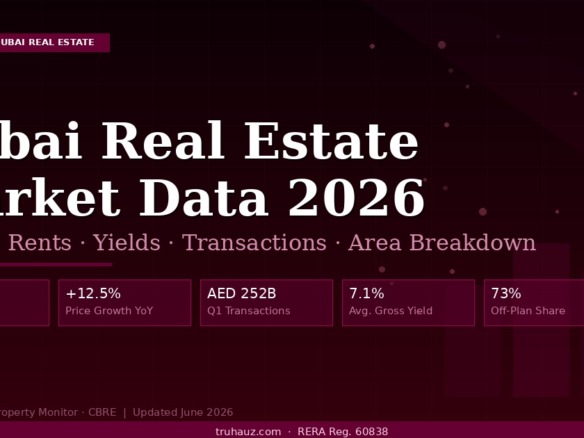
Engel & Völkers Middle East, reported by Emirates 24|7 on 7 September 2026, put average Dubai retail rents at AED 252 per square foot a year in the first half of 2026, up from AED 238 — a rise of 5.9% year on year. The firm attributed the growth to limited availability of high-quality retail space, noting that long leases slow the rate at which good units return to the market.
That diagnosis matters more than the number. Retail rent in Dubai is not rising because construction costs rose or because landlords coordinated; it is rising because the supply of units with proven footfall is close to fixed in the short run, while the number of businesses wanting one is not. A new shopping centre adds floor area but it also redistributes footfall, so new supply does not automatically relieve pressure on the locations that already work.
The earlier evidence points the same way. Cavendish Maxwell found Dubai retail rents rising as much as 15% in some areas in the third quarter of 2025, averaging a 7.7% citywide increase, with the largest increases in Jumeirah Lakes Towers, Business Bay and Dubai Marina. It also recorded Dubai Mall at 98% occupancy. Two independent datasets, a year apart, describing a market where the good space is full.
For a prospective tenant the implication is uncomfortable but clarifying: you are unlikely to find a bargain in a location with strong footfall, and a unit that is both cheap and busy almost certainly has something wrong with it that you have not yet identified. The useful search is not for a low rent but for a rent that is low relative to the trade the unit can actually do.
Dubai retail rents, H1 2026
Engel & Völkers Middle East, via Emirates 24|7, 7 Sep 2026
Citywide averages across all retail formats. Rents vary enormously by centre, street and frontage, and these figures exclude VAT, service charges and fit-out.
Why Renewing Tenants Pay More Than New Ones
One figure in the 2026 data looks like a misprint. Rents on new Dubai retail leases averaged AED 234 per square foot, up 2.2%. Rents on renewals averaged AED 257 per square foot, up 6.6%. The sitting tenants are paying more, and their rents are rising faster.
The intuitive reading — that landlords squeeze captive tenants — is not the most likely one, partly because Dubai’s rent-increase framework constrains exactly that behaviour. A better explanation is selection bias in what reaches the market. Units in strong locations with good trade rarely become available, because the businesses in them renew. The pool of space a new tenant can actually choose from is therefore weighted towards weaker pitches: secondary frontages, newer centres still building footfall, districts in transition. Those units let at lower rents, and they drag the new-lease average down.
Read that way, the gap is not an opportunity. A new tenant cannot walk in and demand AED 234 for a unit that would renew at AED 257; the AED 234 partly describes a different and worse set of units. The same pattern showed up a year earlier, when Cavendish Maxwell recorded Dubai retail renewals rising 6% year on year in the third quarter of 2025 while new rental contracts fell by nearly a third against the previous quarter — fewer new deals, concentrated in weaker space.
There is a practical use for this, though. If you are offered a unit in a prime centre at close to the new-lease average, either you have found something genuinely mispriced or there is a reason the previous occupier left. Ask which, and ask to see the trading history of the pitch rather than the centre.
Dubai Has Five Quite Different Retail Markets
“Shop for rent in Dubai” covers formats with different rent levels, lease structures, tenant mixes and risks. We have deliberately not attached rent figures to each format: we have no sourced per-format benchmark, and an invented one would be worse than none. Compare within a format, never across them.
| Format | Examples of the type | What you are paying for | Main risk |
|---|---|---|---|
| Super-regional mall | The large destination centres | Guaranteed, managed, year-round footfall | Highest rent and strictest lease terms; fit-out and trading hours controlled |
| Community mall | Neighbourhood-scale centres | Repeat local catchment, convenience trade | Catchment can be redrawn by a newer centre nearby |
| Podium & high-street retail | Ground floors of residential and office towers | Resident and worker footfall at the door | Trade depends on building occupancy and on which side of the podium you take |
| Traditional souk districts | Older trading quarters of the city | Dense pedestrian flow and established trade clusters | Older stock, parking and servicing constraints, narrower tenant mix |
| Showroom & light-industrial retail | Industrial districts with showroom use | Large frontage and floor area at a lower rent per sq ft | No passing trade; destination-only, and permitted use is restricted |
The distinction that catches people out is the last one. A showroom unit in an industrial district can look extraordinary value against a mall rent per square foot, and for a business whose customers arrive deliberately — furniture, car accessories, trade supply, workshops — it often is. For a business that depends on someone walking past and deciding to come in, it is not value at all, because the thing you are economising on is the only thing that generates the sale. Our guide to commercial property in Dubai covers how these use classes differ, and our guide to a warehouse for rent in Dubai sets out rents in the industrial submarkets where showroom space sits.
Within any one format, the variable that matters most is not the district but the pitch: which entrance, which floor, which side of a corridor, what is next door. Two units in the same centre at the same rent can trade very differently. This is the one part of a retail decision that no published average can help you with, and the only reliable method is to stand in the unit at several different times of day and count.
Licence First, Then Lease
Zoning and permitted-use approval attach to the specific unit, not to the area. The most expensive mistake in Dubai retail is signing for premises that cannot host the activity you have in mind.
Ejari is the step most often misunderstood, because it sits in the middle of the chain rather than at the end. Registration is mandatory for commercial tenancies on the Dubai mainland; it is what makes the tenancy properly recognised and enforceable, it is the gateway to the Rental Dispute Settlement Centre, and in practice both the mainland licence and the utility connection depend on it. A landlord reluctant to register is telling you something about the premises or their own title.
Build real time into the fit-out and clearance stage. Approvals for fit-out and signage, and the Civil Defence inspection, are sequential rather than parallel, and a first inspection commonly produces a list of items to put right before sign-off. A lease whose rent-free period assumes everything passes first time is a lease that starts charging you rent before you can trade. This is general information rather than legal or regulatory advice: requirements differ by activity and change over time, so confirm your own position with the Department of Economy and Tourism and Dubai Municipality.
What Sits On Top of the Rent
VAT. A shop is commercial property, and the Federal Tax Authority treats supplies of commercial property as taxable at the standard VAT rate of 5%, normally charged to the tenant alongside the rent. Where your business is VAT-registered and the premises are used for taxable business purposes, eligible input VAT may typically be recovered under the normal rules. Our guide to commercial property in Dubai sets out the position with its source.
Service charge and marketing levy. Managed centres recover common-area costs, security, cleaning and often a marketing or promotional contribution. These are charged in addition to rent, they are not always quoted up front, and they are a recurring cost that can meaningfully change the ranking of two units with the same headline rent. Ask for the actual charge for the last two years rather than a budget figure. Our guide to service charges in Dubai explains how such charges are set and audited.
Fit-out, reinstatement and turnover provisions. Shop fit-out is normally the tenant’s cost and can be substantial in a managed centre with design controls. The lease will often require you to strip the unit back at the end of the term, which is a liability you accept at signing and pay for years later. Retail leases also sometimes link part of the rent to sales, or require sales reporting; if your lease does, understand precisely how turnover is defined before you sign, because the definition does more work than the percentage.
At renewal. Dubai’s rent-increase framework is not residential-only. Mainland commercial leases sit under Law No. 26 of 2007 as amended by Law No. 33 of 2008, and increases are governed by Decree No. 43 of 2013, which caps them by reference to how far the current rent sits below the market rate for comparable property. The decree does not distinguish residential from commercial. Given that renewal rents rose 6.6% in the first half of 2026, that framework is the main thing standing between a sitting retailer and an open-ended increase — our guide to the rental index and the legal rent-increase bands explains how the brackets are calculated.
Illustration only
1,000 sq ft at the citywide average
A worked illustration, not a quotation. It multiplies an assumed 1,000 sq ft by the AED 252 per sq ft citywide average published by Engel & Völkers Middle East for H1 2026 and adds VAT at the standard 5% rate. A real unit in a strong centre would cost materially more per square foot than the citywide average, and one in a secondary location materially less. Service charges, marketing levies and fit-out are left unquantified because they are unit-specific and we have no sourced figure for them.
Looking for retail space in Dubai?
Tell us the trade, the catchment you need and the licence you hold, and we will tell you which formats and units actually fit.
Buying Retail Rather Than Renting It
Dubai retail assets crossed a threshold in late 2025, and the figures explain why investors started paying attention — and where the risk in the asset class actually sits.
A record quarter
Cavendish Maxwell recorded Dubai retail asset sales of AED 1.1 billion across 400 transactions in the third quarter of 2025 — the first time retail sales had passed AED 1 billion in a single quarter, with transactions up almost 80% on the previous quarter and nearly 30% year on year.
Where the growth was sharpest
Off-plan retail transactions rose 133% against the previous quarter and 65% year on year on the same figures — buyers committing to units in centres not yet trading. That is a bet on a catchment rather than on an income stream, and it should be underwritten differently from a let unit.
Retail is not passive
Income depends on the tenant trading well, on footfall that a new centre nearby can redirect, and on a letting market where a vacant unit in a weak pitch can stay vacant. Flagship centres continue to attract capital — Cavendish Maxwell cited an AED 5 billion expansion at Mall of the Emirates — but that investment reshapes catchments as well as creating them.
Buying mechanics follow any Dubai commercial asset: title registers through the Dubai Land Department, the transfer registration fee is 4% of the sale value, and VAT applies in a way it does not for residential property. See our guides to DLD fees و rental yield and ROI.
پرسشهای متداول
The questions retailers ask most often before signing a lease in Dubai.
Retail Is a Footfall Decision, Not a Rent Decision
TruHauz works through the format, the pitch, the licence and the true occupancy cost before you commit to a unit. Tell us what you intend to trade and who your customer is.

به بحث بپیوندید