
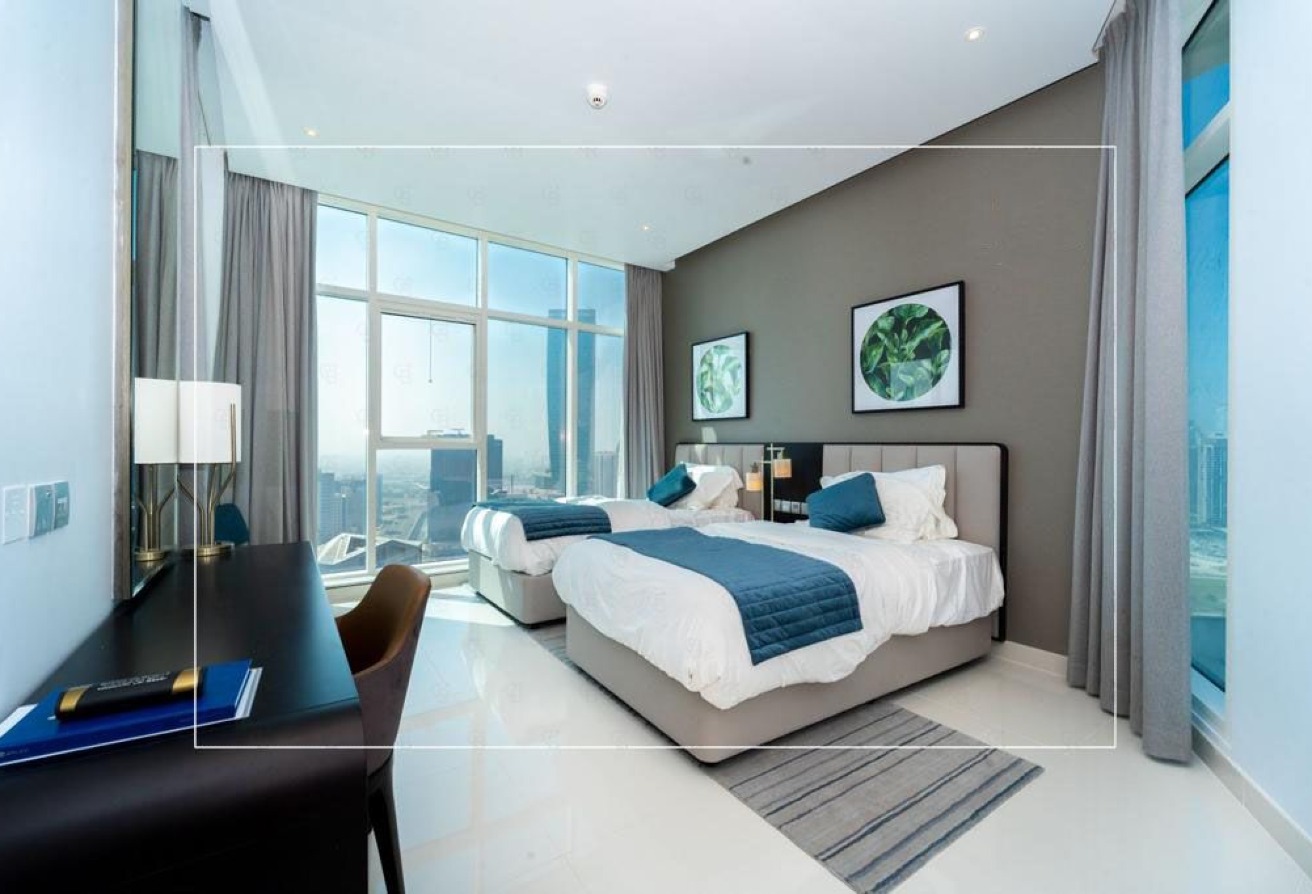
Hotel Apartments in Dubai for Monthly Rent
What They Cost, What Is Included, and Why They Are Not Tenancies
A hotel apartment looks like an apartment and bills like a hotel. You get a furnished home with housekeeping and a one-signature move-in, no Ejari, no cheques and no agency commission — and in exchange you give up the rent-cap protection and the dispute forum that an ordinary Dubai lease carries. Here is the real monthly pricing, the licensing framework behind it, and how to decide between a hotel apartment, a holiday home and a conventional lease.
A Hospitality Product, Not a Rental Contract
Most people arrive at hotel apartments from the rental market. They have priced a conventional one-bedroom, discovered it needs a year’s rent in a small number of cheques, a security deposit, an agency commission, a DEWA account, an Ejari registration and furniture — and started looking for something that can be arranged in an afternoon. A hotel apartment can be.
What makes that possible is not a more relaxed landlord. It is that a hotel apartment is legally a different thing. It is a hotel establishment operating under a tourism licence, and your stay is a hospitality booking rather than a lease. That one fact explains everything downstream: why the rent is quoted monthly rather than annually, why the bills and the cleaning are bundled, why nobody asks you for post-dated cheques — and why none of Dubai’s tenant protections attach to you.
That trade is reasonable for some people and a bad deal for others. A consultant on a six-month posting, a family between a sale and a handover, or an owner waiting out a renovation is usually better off in a hotel apartment than signing a twelve-month lease they will break. Someone intending to stay three years and build a stable cost base almost certainly is not.
Hotel Apartment vs Ordinary Lease
The structural differences at a glance
What a “Hotel Apartment” Legally Is
Dubai regulates hotel apartments through Decree No. 17 of 2013 Concerning Licensing and Classification of Hotel Establishments in the Emirate of Dubai. Article 1 of that decree sets out what counts as a Hotel Establishment, and the list is broad: it includes hotels, resorts, hotel apartments, guest houses and university dormitories, as well as youth hostels, budget hotels, floating hotels and any other type the licensing authority specifies.
Article 7 then sets the classification tiers for each type. For hotel apartments the decree lists exactly three: luxury, deluxe and standard. The decree does not itself define what earns a building each tier — it provides that the category is determined according to standards and requirements prescribed by a resolution of the Director General, and it allows the Director General to add further establishment types and categories.
Two details in the decree matter more to a prospective occupant than they first appear. The first is Article 4, which makes the tourism authority the competent entity in the Emirate responsible for licensing and classifying hotel establishments. The decree as drafted names the Department of Tourism and Commerce Marketing; Dubai’s tourism licensing function now sits with the Department of Economy and Tourism, which is the body you will see named on current licences and on the paperwork for related products such as a Dubai holiday home licence.
The second is Article 6, under which the operating licence runs for one year, renewable for the same period, with provision for the authority to extend it up to four years on request. A hotel apartment’s right to operate is therefore a periodically renewed permission, not a permanent status. If you are about to commit several months of rent to a building, that is a licence worth asking to see.
What the decree conspicuously does not contain is any provision about leases, tenancy of hotel apartment units, or how long a guest may stay. It regulates the operator, not the occupancy. There is no statutory minimum or maximum stay in a hotel apartment, which is precisely why monthly — and multi-month — bookings are a normal part of the product rather than an exception to it.
Why Dubai’s Tenancy Law Does Not Reach You
Dubai’s landlord and tenant relationship is governed by Law No. 26 of 2007, as amended by Law No. 33 of 2008. Article 3 of that law sets its scope: it applies to leased real property in the Emirate, including vacant and agricultural land, “excluding hotel establishments and Real Property provided by natural or legal persons as accommodation to their employees at no charge.”
Read those two instruments together and the position becomes clear. Decree No. 17 of 2013 treats hotel apartments as a type of hotel establishment. Law No. 26 of 2007 excludes hotel establishments from the tenancy regime. A stay in a properly licensed hotel apartment therefore sits outside the law that protects Dubai tenants — not because of anything in your booking contract, but because of what the building is.
Three concrete protections fall away with that exclusion, and it is worth being specific about each.
You do not get Ejari, and you do not need it. Ejari registration is what makes a Dubai tenancy contract properly recognised and enforceable, and it is the gateway to a number of ordinary administrative steps. A hotel apartment booking is not a tenancy and so is not registered on Ejari. This is usually presented as a convenience, and in day-to-day terms it is. But Ejari is also what you produce when you need to prove where you live for a visa application, a school registration, a DEWA account in your own name or a bank process. If any of those steps are ahead of you, establish early what documentation the operator can give you instead, because a hotel invoice is not always an accepted substitute.
You do not get rent-increase protection. Residential rent increases in Dubai are constrained by Decree No. 43 of 2013, which sets five brackets according to how far the current rent sits below the market rate — the mechanism explained in our guide to the Dubai rental index and legal rent-increase bands. A hotel apartment rate is a commercial room rate. It moves with season, occupancy and demand, and nothing caps the movement. A rate agreed in a quiet summer month can be repriced sharply for the winter season, and that is a normal feature of hospitality pricing rather than a breach of anything.
You do not get the Rental Dispute Centre. The Rental Dispute Settlement Centre, established by Decree No. 26 of 2013, has jurisdiction over disputes arising from registered tenancy contracts on the Dubai mainland — the process our guide to the Rental Dispute Centre describes. Without a registered tenancy there is no route into that forum. A dispute with a hotel apartment operator over a deposit, a charge or an early departure is a commercial dispute, resolved under the booking terms and, failing that, through ordinary civil channels or a complaint to the licensing authority. That is a materially slower and less predictable path, which is why the cancellation and refund clauses in a hotel apartment agreement deserve a careful read — they are the whole of your protection, not a supplement to it.
For comparison, the anatomy of what you are giving up is set out in our guide to the Dubai tenancy contract.
What Monthly Rents Actually Look Like
There is no official index for this market, so the honest source is portal advertising. The figures below were taken from Propertyfinder’s Dubai furnished hotel apartments monthly-rent listing page, retrieved on 16 October 2026. On that date the page showed 598 hotel apartments advertised for monthly rent across Dubai, stated that monthly rent “averages close to AED 20,000”, and put the entry point at around AED 6,000 per month.
Treat all of this as asking prices. Advertised rents are what operators hope to achieve, they skew towards whatever is currently unlet, and portal averages are arithmetic means dragged upward by a handful of large penthouses. They are useful for calibrating expectations and useless as a valuation.
| Unit type | Advertised monthly average | Size range quoted | Market tier |
|---|---|---|---|
| استودیو | approx. AED 14,750 | 280 – 550 sq ft | ورود |
| ۱ خواب | approx. AED 17,000 | 430 – 850 sq ft | Core |
| ۲ خوابه | approx. AED 25,000 | 797 – 818 sq ft | خانواده |
| سه خوابه | approx. AED 33,000 | 1,087 – 2,088 sq ft | Upper |
Source: Propertyfinder, Dubai furnished hotel apartments for monthly rent, retrieved 16 October 2026. Advertised asking prices, not transactions.
The spread within a single area is wider than the spread between unit types. Propertyfinder’s Dubai Marina hotel apartment page, retrieved the same day, showed only 35 units advertised for monthly rent with a quoted price range of AED 7,600 to AED 60,000 per month — the floor being a studio at Millennium Place Marina. The page’s stated average for that area was expressed annually, at AED 170,800 per year. At the budget end, the same portal cited studio hotel apartments from around AED 4,499 per month in Dubai Media City, below the AED 6,000 city-wide entry point, which is a reminder that the cheapest stock sits in the business parks and the older inland districts rather than on the water.
If you are weighing a monthly hotel apartment rate against simply buying, our guides to studio apartments for sale in Dubai و apartments in Dubai Marina set out the purchase-side numbers for the same unit types, and Dubai property prices covers the broader market.
What Is Actually Included — and What Is Not
The appeal of a hotel apartment is that one monthly figure replaces about six separate arrangements. Furniture, white goods, kitchenware and linen come with the unit. Utilities are normally bundled, which removes the DEWA deposit and account setup. Housekeeping runs on a stated frequency. Wi-Fi and often television subscriptions are included. Building amenities — pool, gym, sometimes a reception desk and parking — come with the licence rather than with a separate access card. And because the operator is renting its own inventory, there is normally no agency commission and no requirement to produce a year of post-dated cheques.
Equally important is what is bundled on the owner’s side and therefore not your problem. Service charges sit with the owner, as does building maintenance and the replacement of anything that fails. Dubai levies no annual property tax on ownership — the position set out in our guide to Dubai property tax — so there is no occupancy tax line to anticipate either.
The items that catch people out are narrower but real, and all of them are answerable before you book:
Housekeeping frequency and what it covers. “Housekeeping included” ranges from daily servicing to a weekly linen change. Ask for the frequency in writing, and ask whether a deep clean at departure is charged separately.
Utility fair-use caps. Bundled utilities frequently carry a monthly consumption allowance, with the excess rebilled. In a Dubai summer, a unit run cold around the clock can exceed a cap comfortably. Ask what the allowance is and what the overage rate is.
The municipality fee question. Dubai applies a housing fee to residential tenancies, collected through DEWA, as our guide to the Dubai municipality housing fee explains. Hotel establishments are billed differently, and a hotel apartment rate is normally quoted as an inclusive figure. Confirm whether the quoted rate is gross of all municipal and tourism charges or whether anything is added at checkout.
The Tourism Dirham. Dubai’s Tourism Dirham is charged per occupied room per night and varies by the establishment’s classification. Published commercial guides consistently describe it as capped at thirty consecutive nights, which would make it a meaningful but bounded line on a monthly stay. We are not quoting a rate for hotel apartments here: the sources we checked disagree on which tier applies to deluxe and standard hotel apartments, and we could not retrieve the current official schedule. Ask the operator for the exact per-night figure and the cap as applied to your booking, and have it confirmed on the invoice.
Deposit, cancellation and extension terms. Because the Rental Dispute Centre is not available to you, the contract is the remedy. Read the deposit refund mechanism, the notice period for departure, the penalty for leaving early and the basis on which the rate can be changed if you extend. If the agreement is silent on how an extension is priced, assume it will be priced at the prevailing seasonal rate.
Hotel Apartment, Holiday Home, or Conventional Lease
Three different products compete for the same furnished-monthly search, and they sit under three different regimes. Choosing well is mostly a matter of matching the regime to how long you intend to stay.
| Hotel apartment | Holiday home | Conventional lease | |
|---|---|---|---|
| Regime | Hotel establishment licence | Holiday home licence | Law No. 26 of 2007 |
| Ejari | خیر | خیر | Yes, mandatory |
| Rent caps | هیچ | هیچ | Decree 43 of 2013 brackets |
| Dispute forum | Contract / civil | Contract / civil | Rental Dispute Centre |
| Furnished | Always | Always | Usually not |
| Bills | Normally included | Normally included | Tenant’s own accounts |
| Commission | Normally none | Normally none | Agency fee typical |
| بهترین برای | 1 – 9 months | Days to weeks | 12 months plus |
The holiday home column deserves a caveat. Holiday homes are licensed individually and operate under their own classification framework — the rules, fees and fines are set out in our guide to the Dubai holiday home licence. They are built for short stays and priced accordingly, so a monthly booking in one is usually either a negotiated off-season rate or an operator filling a gap. A licensed hotel apartment is the more natural home for a multi-month stay, and the two licences are not interchangeable.
If the obstacle to a conventional lease is the cash flow rather than the commitment, there is a third path worth knowing about. The Dubai Land Department’s instalment scheme lets qualifying tenants pay rent monthly against a conventional registered tenancy, which keeps the Ejari, the rent-cap protection and the dispute forum intact while removing the cheque problem. Our guide to Flexi Rent in Dubai explains how it works and who qualifies, and rent now, pay later in Dubai covers the private-sector equivalents. For many people on a twelve-month horizon, that is a strictly better answer than a hotel apartment.
One thing none of these products is: a workaround for sharing. Dubai regulates occupancy density, and the approved framework for shared accommodation is set out in our guide to Dubai shared housing and the approved areas. A hotel apartment’s licence does not create room to sub-divide a unit or re-let a bedroom.
Buying Into the Serviced and Branded Segment
The same product read from the ownership side is a different proposition. A serviced or branded residence is an apartment you own freehold, which an operator runs as part of a managed pool. You receive a share of the income the operator generates rather than a tenant’s rent, net of the management share and the operating costs.
The structural attraction is that the income is generated at nightly and monthly hospitality rates rather than at annual lease rates, and that the operator absorbs the furnishing, the marketing and the churn. The structural cost is that you are exposed to occupancy rather than to a twelve-month covenant, that the management agreement takes a meaningful share, and that the cost base is higher: a serviced building carries heavier service charges than an equivalent unserviced one, because the amenity and staffing levels are higher.
We are not publishing yield figures for this segment. Returns in a managed pool depend on the specific operator agreement, the revenue-share split, the furnishing obligation and the building’s actual occupancy, and a single headline percentage across the segment would be meaningless. Any number worth acting on comes out of the management agreement and the operator’s historical statements for that specific building, and those are documents to read before you commit rather than after.
Four questions decide whether a given branded or serviced unit is worth owning, and all four are answerable from the paperwork. What share of gross or net revenue reaches the owner, and is it calculated before or after operating costs? What is the term of the management agreement, and can you exit it or let the unit yourself? Who funds furniture replacement and refurbishment cycles? And what does the building’s service charge actually run at, as distinct from what the sales brochure projects?
A further consideration applies if the unit is to be let short-term by anyone other than a licensed hotel operator: the activity requires its own licence, and the obligations are not trivial. Our guide to the Dubai holiday home licence sets out the regime, the fees and the penalties. On the transaction itself, DLD fees in Dubai covers the registration cost of acquiring the unit, and buying property in Dubai as a foreigner covers eligibility and process. TruHauz lists branded and serviced stock across Dubai, including Emaar apartments and the serviced inventory in خلیج کسبوکار.
Who Should Rent One — and Who Should Not
Rent a hotel apartment if your horizon is under about nine months. New arrivals before a long-term decision, consultants and project staff on fixed postings, families bridging a sale and a handover, owners displaced by renovation, and anyone who cannot yet produce the documentation a conventional lease and a DEWA account require. For all of these, the premium over an annual lease buys genuine optionality, and the protections you forfeit are ones you would never have had time to use.
Do not rent one if you intend to stay a year or more. Over a twelve-month horizon the inclusive monthly rate is normally the more expensive way to house yourself, and you are paying that premium to give up rent-cap protection, Ejari documentation and access to the Rental Dispute Centre. If the barrier is the cheque structure rather than the commitment, solve the cheque structure — through Flexi Rent or a private instalment product — and keep the protections.
And if the arithmetic of a long stay is pushing you towards buying instead, that is often the right instinct. Our guides to studio apartments for sale in Dubai و cheap villas for sale in Dubai set out the entry points, and the Dubai First-Time Home Buyer Programme covers what is available to first-time purchasers.
پرسشهای متداول
The questions renters and investors ask most often about hotel and serviced apartments in Dubai.
Furnished, Flexible, or Simply Overpriced?
TruHauz advises on both sides of this market: the monthly furnished stay that actually fits your horizon, and the serviced or branded unit worth owning. Tell us which side you are on.


به بحث بپیوندید