
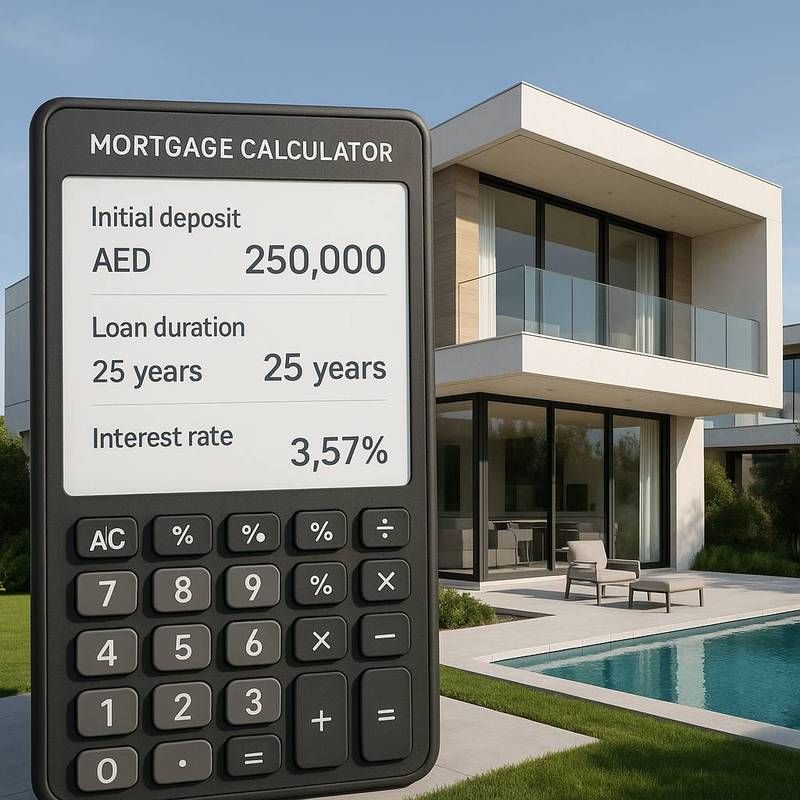
How to Get a Mortgage in Dubai
LTV Caps, the 50% Debt Rule and What You Pay in Cash
Dubai lending is governed by a small set of hard ceilings — how much a bank may lend against value, how much of your income may go to debt, how long the term can run. Learn those first and the rest of the process is administration. Here is the framework, the real cost of borrowing, and the cash you need on the day.
Three Ceilings Decide What You Can Borrow
Mortgage lending in the UAE is not a free negotiation between you and a bank. It sits inside a framework set by the Central Bank of the UAE, and almost every disappointment borrowers experience in Dubai comes from not knowing where the edges of that framework are before they start looking at property.
Three ceilings do most of the work. The first is loan-to-value — the share of the property’s assessed value a bank may lend against. The second is the debt burden ratio, which caps total monthly debt repayments at 50% of monthly income. The third is tenure and age: a maximum term of 25 years, and repayments that must finish before a stated age. Whichever of the three binds first is the one that decides your number, and for salaried buyers with existing car or personal finance it is very often the debt burden ratio rather than the deposit.
The loan-to-value ceilings reported by dataHabibi (11 July 2026) and Grovy (3 July 2026) are 80% for a resident expatriate’s first home up to AED 5 million, 70% above that threshold, and 60% on a second or investment property. UAE nationals sit higher at 85%, 75% and 65%. Anything bought off-plan is capped at 50% for every category of buyer — a rule significant enough that we have covered it separately in our guide to off-plan mortgages in Dubai. Every one of these ceilings is set by the Central Bank and binds Shari’ah-compliant lenders on identical terms, as our guide to the Islamic mortgage in Dubai explains.
A change in early 2025 made the cash side materially harder. The National reported on 25 January 2025, and Khaleej Times on 26 January 2025, that from 1 February 2025 banks would stop financing the 4% Dubai Land Department registration fee and the 2% brokerage commission as part of a mortgage. Those costs had commonly been rolled into the loan. They are now money you must have in the account. On an AED 1 million purchase, Khaleej Times put the additional upfront requirement at roughly AED 60,000.
None of this makes Dubai a difficult place to borrow. Rates are competitive, the process is fast by international standards, and the absence of annual property tax, capital gains tax and tax on rental income means the running cost of a financed Dubai asset is unusually low — as our guide to Dubai property tax sets out. It simply means the deposit is not the whole of the deposit, and the arithmetic is worth doing before you make an offer rather than after.
Dubai Mortgage Rules at a Glance
The ceilings that decide your number
Loan-to-Value Caps by Buyer and Property Type
These are regulatory maximums, not entitlements. A bank may lend less than the cap — it may not lend more.
| Buyer & Property | Maximum LTV | Minimum Deposit | Note |
|---|---|---|---|
| Resident expat · first home ≤ AED 5M | 80% | 20% | Most common case |
| Resident expat · first home > AED 5M | 70% | 30% | Threshold effect |
| Resident expat · second or investment property | 60% | 40% | Applies per additional unit |
| UAE national · first home ≤ AED 5M | 85% | 15% | Highest ceiling |
| UAE national · first home > AED 5M | 75% | 25% | Threshold effect |
| UAE national · second or investment property | 65% | 35% | Per additional unit |
| Any buyer · off-plan purchase | 50% | 50% | No exceptions |
| Non-resident overseas buyer | Typically 50–60% | 40–50% | Bank policy, not a cap |
Loan-to-value ceilings as reported by dataHabibi, “Mortgage in Dubai 2026: Rates & LTV Limits”, published 11 July 2026, and by Grovy, “UAE Mortgage Rules 2026: LTV Limits & Buyer Guide”, published 3 July 2026, both citing Central Bank of the UAE mortgage regulations. The non-resident range is lender policy rather than a published regulatory cap and is reported by Grovy. Individual bank criteria are stricter than these ceilings in most cases — confirm with your lender.
Six Steps From Enquiry to Title Deed
The sequence is fixed. Knowing which step you are on tells you what can still change and what is already committed.
Want your borrowing capacity worked out properly?
Send us your income, your existing commitments and the property you are considering. TruHauz will map it against the caps before you commit to anything.
Three Things the Headline LTV Does Not Tell You
Each of these has turned an approved buyer into a stalled one. All three are knowable in advance.
The fees are now cash
Since 1 February 2025 banks do not finance the 4% DLD fee or the 2% agency commission. That is roughly six percentage points of the purchase price that used to sit inside the loan and now has to sit in your account, on top of the deposit.
The DBR counts everything
The debt burden ratio caps all monthly debt repayments at half your monthly income — car finance, personal loans and credit card minimums included. Many applicants hit this ceiling well before they hit the loan-to-value one, which is why clearing a car loan can raise a mortgage offer more than a larger deposit does.
LTV applies to value, not price
The percentage is applied to the bank’s own valuation, not to the price you negotiated. If the valuation comes in below the agreed price, the shortfall is funded entirely by you — the bank does not stretch its ratio to close the gap.
Frequently Asked Questions
The questions buyers ask most often about getting a mortgage in Dubai.
This guide is general information about how mortgage lending works in Dubai, drawn from the sources named and dated throughout. It is not legal, tax or financial advice, and it is not a recommendation of any lender or product. Regulatory caps, bank criteria and fee schedules change. Confirm current terms with your lender and take independent advice before committing to a facility.
Know What You Can Borrow Before You Offer
TruHauz works the caps, the debt burden ratio and the full cash requirement against your actual position — so the budget you shop with is the budget you can complete on. Tell us what you are considering.


Join The Discussion