

Off-Plan Handover Delay in Dubai
What the Law Actually Gives You
The “12-month grace period” repeated across Dubai property blogs is not in any Dubai statute. It is a contract term. Here is what the emirate’s legislation genuinely provides when a developer misses a handover date, where your remedy really comes from, and which figures we could not source at all.
Dubai Legislated Both Ends, and Left the Middle to Contract
Dubai’s off-plan legislation is unusually detailed by regional standards, and it is detailed in two specific places. It regulates, at length, the buyer who stops paying. And it regulates, through a separate law and a dedicated tribunal, the project that collapses entirely. Between those two poles sits the situation most off-plan buyers actually face: a project that is genuinely being built, and is genuinely late.
For that middle case the statute is close to silent, and understanding why matters more than memorising any single provision. Article 11 of Law No. (13) of 2008, as amended by Law No. (19) of 2017, is the article most often cited to delayed buyers. Read it and you find it does something else entirely: it sets out the procedure a developer may follow against a purchaser who has breached, including a thirty-day notice issued by the Department and a schedule of how much the developer may retain depending on how far construction has progressed. The Dubai Legislation Portal’s own explanatory note on that article describes exactly that, and nothing about developer delay.
The consequence is practical rather than abstract. If your handover date has passed, the document that decides what you are owed is your own sale and purchase agreement, not a provision of Dubai property law that someone can quote at the developer. That is a weaker position than most buyers assume they are in, and it is the reason the delay clause deserves to be read before the brochure.
None of this makes the buyer unprotected. It means the protection is structural rather than procedural. The money you have paid does not sit with the developer; it sits in a project escrow account governed by Law No. (8) of 2007, and that law does impose obligations that bite when a project stops progressing. Your interest in the unit is recorded in the Interim Property Register through Oqood registration, without which the disposition is void. And where the regulator cancels the project outright, a separate machinery takes over, which we cover in detail in our guide to a cancelled Dubai off-plan project.
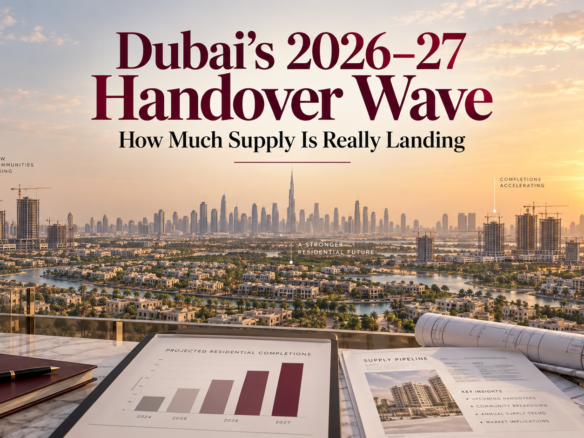
Context matters too. Dubai is working through an exceptionally large completion programme, and the scale of what is scheduled to land is set out in our analysis of the 2026–27 handover wave. A delivery pipeline of that size makes slippage a statistically ordinary event rather than a sign of developer failure, which is precisely why buyers need to be able to tell the two apart.
What Dubai Statute Does Say
Verified against the Dubai Legislation Portal, 22 Sep 2026
What the Legislation Says, Article by Article
Each row below was read against the published text of the instrument named in the third column. Where a commonly repeated claim is not supported by any instrument we could find, the table says so rather than filling the gap.
| Provision | What it says | Instrument | Source |
|---|---|---|---|
| No statutory delay grace period | Nothing in the off-plan legislation sets a tolerance window for late handover. Article 11 governs purchaser breach, not developer delay. | Law No. (13) of 2008, Art. 11, as amended by Law No. (19) of 2017 | Dubai Legislation Portal, explanatory note on Art. 11 |
| Commencement of works | The developer must commence construction works after the lapse of six (6) months from the date on which he was granted permission to sell units off-plan. | Law No. (8) of 2007, Art. 17(2) | Dubai Legislation Portal |
| Escrow retention | The escrow agent must retain five per cent (5%) of the total value of each escrow account once the developer obtains the completion certificate. | Law No. (8) of 2007, Art. 14 | Dubai Legislation Portal |
| Release of retention | The retained amount is released to the developer one (1) year from the registration of the units in the name of the purchasers. | Law No. (8) of 2007, Art. 14 | Dubai Legislation Portal |
| Project not completed | In an emergency situation where the project is not completed, the escrow agent must, after consultation with the Department, preserve depositors’ rights and ensure completion or refund. | Law No. (8) of 2007, Art. 15 | Dubai Legislation Portal |
| Registration or void | Off-plan dispositions must be entered in the Interim Property Register or they are void. | Law No. (13) of 2008, Art. 3 | Dubai Legislation Portal |
| Selling before approvals | Developers may not commence projects or sell units off-plan before obtaining possession of the land and the approvals of the competent entities. | Law No. (13) of 2008, Art. 4 | Dubai Legislation Portal |
| Area variance on handover | The developer may not charge for an increase in area and must compensate for a material decrease. | Law No. (13) of 2008, Art. 12 | Dubai Legislation Portal |
| Notice on purchaser breach | On breach by the purchaser the developer notifies the Department, which serves thirty (30) days’ notice and attempts mediation. | Law No. (13) of 2008, Art. 11 | Dubai Legislation Portal, explanatory note |
| Force majeure | Where a force majeure makes performance impossible the corresponding obligation is extinguished and the contract rescinded; partial impossibility extinguishes the consideration for that part. | UAE Civil Transactions Law, Federal Law No. (5) of 1985, Art. 273 | UAE Ministry of Justice e-laws portal |
| Cancelled projects | Refunds where the regulator cancels a project; liquidation handled by a dedicated special tribunal. | Law No. (19) of 2017, Art. 11(b); Decree No. (33) of 2020 | Dubai Legislation Portal |
Sources retrieved 22 September 2026: Law No. (8) of 2007 Concerning Escrow Accounts for Real Estate Development and Law No. (13) of 2008 Regulating the Interim Property Register, both from the Dubai Legislation Portal (dlp.dubai.gov.ae), together with the portal’s Explanatory Notes on Article (11) of Law No. (19) of 2017; Article 273 of Federal Law No. (5) of 1985 from the UAE Ministry of Justice e-laws portal. We could not source a published figure for the proportion of Dubai projects currently running late, a standard tariff or formula for delay compensation, or any official grace period, so none appears above.
Six Moves When Your Handover Slips
None of these are a substitute for advice on your own agreement. They are the things worth doing before, and while, you take it.
Before anything else, find the clause that names the anticipated completion date and the tolerance attached to it. That clause, not a statute, is what sets your position. Note whether the tolerance runs from a stated date or from a permit milestone, and whether it is extendable.
A project that is progressing and a project that has stalled are different problems with different answers. Your interest sits in the Interim Property Register via Oqood, and registered project information sits with the Land Department.
Correspondence that establishes when you raised the delay, what the developer said, and what was promised in reply is the material any later claim is built from. Verbal reassurance from a sales office is worth very little afterwards.
Your payments sit in a project escrow account. Article 15 obliges the escrow agent, in an emergency situation where the project is not completed, to act after consulting the Department to preserve depositors’ rights. See our guide to Dubai escrow accounts.
If the regulator cancels the project, a different and considerably more defined machinery applies under Law No. (19) of 2017 and Decree No. (33) of 2020. That route is set out in our guide to cancelled projects.
A delayed unit still has to be inspected properly, and the five per cent escrow retention sits behind that first year. Our guide to snagging and handover rights covers what to do on the day the keys finally appear.
Holding a unit that has missed its date?
Talk to TruHauz →Why the Silence Is Probably Deliberate
Three observations that follow from reading the instruments rather than the commentary around them.
The protection was built upstream, not downstream
Rather than legislate a remedy for lateness, Dubai legislated to make lateness less catastrophic. Money goes into escrow instead of to the developer. Sales cannot begin before land possession and approvals. An unregistered disposition is void. Works must start within six months of the sale permit. Each of those is a control applied before the delay happens, and together they explain why a specific delay remedy may have been judged unnecessary.
Force majeure is narrower than it is used
Article 273 of the Civil Transactions Law addresses impossibility, not difficulty. Its text extinguishes the obligation and rescinds the contract where force majeure makes performance impossible, and deals with partial impossibility by extinguishing the consideration for that part. A contractor shortage or a funding squeeze is not obviously impossibility. Where a developer invokes force majeure for a delay, the question is whether the event meets that threshold or merely makes delivery harder.
Nobody publishes what a delay is worth
We looked for a published tariff, formula or average award for handover-delay compensation in Dubai and could not find one from a source we would be willing to name. Outcomes appear to turn on the individual agreement and the individual facts. Any page quoting you a standard percentage of the purchase price for delay should be treated with suspicion until it shows you where the number comes from.
Off-Plan Handover Delay: Common Questions
Answers below are drawn from the published instruments named in the table above. They are general information, not legal advice.
Check the Delay Clause Before You Sign
TruHauz reads the completion and tolerance provisions on every off-plan agreement we advise on, and checks the registered project position before a client commits. Tell us which project you are looking at.
Join The Discussion